Many students, learners and beginners get confused about yea vs nay. Both words mean yes and no, but they sound old fashioned and are mostly used in formal or historic English. Sometimes people mix up yea vs yes or nay vs no.
This guide will explain the difference between yea and nay, give modern examples, and teach you how to use them correctly in daily life, writing, and voting.
Quick Answer: Yea vs Nay
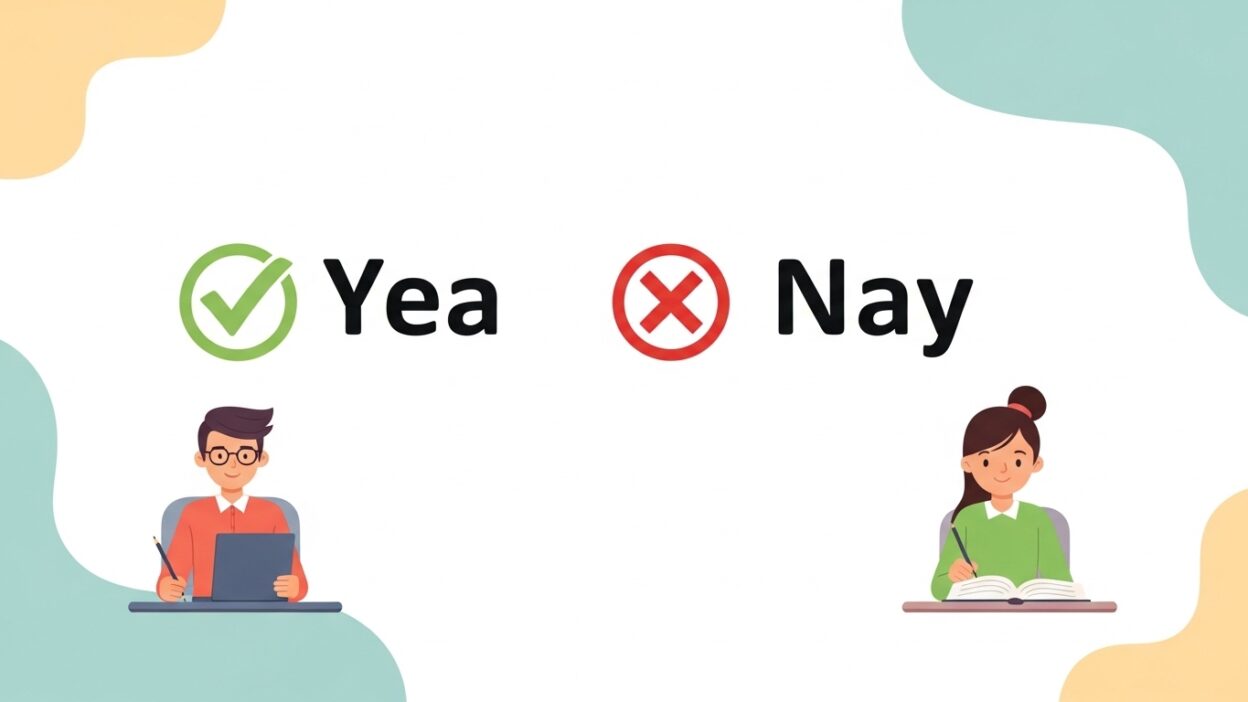
- Yea = Yes / Agreement ✅
- Nay = No / Disagreement ❌
- Yea is positive and shows support.
- Nay is negative and shows refusal or disagreement.
- Mainly used in formal voting, government documents, or historic texts.
- In casual conversations, use yes or no.
Origin and Background
- Yea and nay are Old English words, used since the 1200s.
- They were common in parliaments and official votes:
- “All in favor, say yea.”
- “All against, say nay.”
- “All in favor, say yea.”
- Over time, yes and no became the common words in everyday life.
- Today, yea and nay are mostly seen in books, movies, historic speeches, and government reports.
Clear Explanation of the Difference
- Yea meaning: yes, approval, or agreement.
- Example: “Do you want to join the project? – Yea!”
- Example: “Do you want to join the project? – Yea!”
- Nay meaning: no, refusal, or disagreement.
- Example: “Do you support this idea? – Nay.”
- Example: “Do you support this idea? – Nay.”
Tip: Think of yea as yes and nay as no, but in formal or historic English.
Yea vs Nay: Comparison Table
| Word | Meaning | Use Today / Context | Example Sentence |
| Yea | Yes / Agree | Formal, historic, voting | “The proposal was accepted, yea!” |
| Nay | No / Disagree | Formal, historic, voting | “The motion was rejected, nay.” |
| Yeah | Yes (casual) | Informal / everyday conversation | “Yeah, I’m free this evening.” |
| Nope | No (casual) | Informal / everyday conversation | “Nope, I don’t want to go.” |
Which One to Use and When
- Use “yea”: in formal votes, historic sentences, or literature.
- Use “nay”: in formal votes or historic documents.
- Use “yes” and “no”: in daily conversations, emails, or messages.
- Modern tools: Social media polls or apps sometimes ask: “Yea or Nay?” ✅❌
Common Mistakes People Make
- Using “yea” in casual speech
- ❌ “Yea, I’m going shopping.”
- ✅ “Yes, I’m going shopping.”
- ❌ “Yea, I’m going shopping.”
- Confusing “nay” with casual words like “nope”
- Nay is formal, strong, and negative.
- Nay is formal, strong, and negative.
- Mixing “yea” with “yeah”
- Yea = formal yes
- Yeah = casual yes
- Yea = formal yes
- Thinking they are only historic words
- They still appear in government meetings, voting reports, and historic movies.
- They still appear in government meetings, voting reports, and historic movies.
Everyday Examples
Even though yea and nay are formal, they appear in real life:
- Emails:
- “The board approved the new policy, yea.”
- “The suggestion was rejected, nay.”
- “The board approved the new policy, yea.”
- News reports:
- “The bill passed with 220 yea votes and 30 nay votes.”
- “The bill passed with 220 yea votes and 30 nay votes.”
- Social media / polls:
- “Do you want a new school uniform? Yea or nay?” ✅❌
- “Do you want a new school uniform? Yea or nay?” ✅❌
- Classroom or learning games:
- Teacher: “Do you like ice cream?” → Students: “Yea!”
- Teacher: “Do you want homework now?” → Students: “Nay!”
- Teacher: “Do you like ice cream?” → Students: “Yea!”
Short Learning Section for Students
- Step 1: Remember the rule:
- Yea = Yes / Agreement
- Nay = No / Disagreement
- Yea = Yes / Agreement
- Step 2: Practice with examples:
- Teacher asks: “Do you like math?” → Answer: Yea
- Teacher asks: “Do you want to skip class?” → Answer: Nay
- Teacher asks: “Do you like math?” → Answer: Yea
- Step 3: Know casual alternatives:
- Yeah = yes (casual)
- Nope = no (casual)
- Yeah = yes (casual)
- Step 4: Practice in real-world contexts:
- Voting games, quizzes, or historic stories.
- Voting games, quizzes, or historic stories.
Mini Exercise
Choose the correct answer (Yea or Nay):
- “Do you support the new rule?” → ___
- “Do you want more homework?” → ___
- “The motion passed. All in favor, say ___.”
- “All against, say ___.”
(Answers: 1 – Yea, 2 – Nay, 3 – Yea, 4 – Nay)
FAQ
- What is the difference between yea and nay?
- Yea = yes / agreement, Nay = no / disagreement.
- Yea = yes / agreement, Nay = no / disagreement.
- Can I use “yea” instead of “yes” in daily conversation?
- Not usually. Yea sounds formal or old-fashioned.
- Not usually. Yea sounds formal or old-fashioned.
- Is “nay” still used in modern English?
- Yes, mainly in voting, government, and historic texts.
- Yes, mainly in voting, government, and historic texts.
- What is the difference between yea, yeah, and yup?
- Yea = formal yes
- Yeah = casual yes
- Yup = very casual yes
- Yea = formal yes
- Can I use “yea” and “nay” in text messages or social media?
- Yes, mostly for fun, polls, or historic-themed posts.
- Yes, mostly for fun, polls, or historic-themed posts.
- Do yea and nay appear in British and American English?
- Yes, in formal documents, voting, and historical contexts.
- Yes, in formal documents, voting, and historical contexts.
- Can students learn yea and nay for exams?
- Yes, it helps with historic literature, formal English, and voting context.
- Yes, it helps with historic literature, formal English, and voting context.
- What are other formal English words for yes and no?
- Affirmative, agree, approve = yes
- Negative, decline, refuse = no
- Affirmative, agree, approve = yes
Conclusion
Understanding yea vs nay is simple: yea = yes, nay = no. These words come from old English and are mostly used in formal voting, historic texts, and literature.
In modern life, yes and no are more common, but knowing yea and nay meaning helps you read, write, and understand historic or formal English.
By practicing examples, mini exercises, and modern scenarios, you can confidently use and recognize yea vs nay, yea vs yes, and nay vs no anywhere.