Many students search for women vs woman because the words look almost the same but sound different. One small spelling change can change the meaning of your whole sentence.
Some learners also get confused about:
- The plural form
- Pronunciation
- Verb agreement
- Possessive forms like “women’s”
- Similar words like “girl” or “lady”
This guide will remove all confusion step by step in very simple English. After reading this, you will clearly understand the difference between woman and women and use both words correctly.
Quick Answer
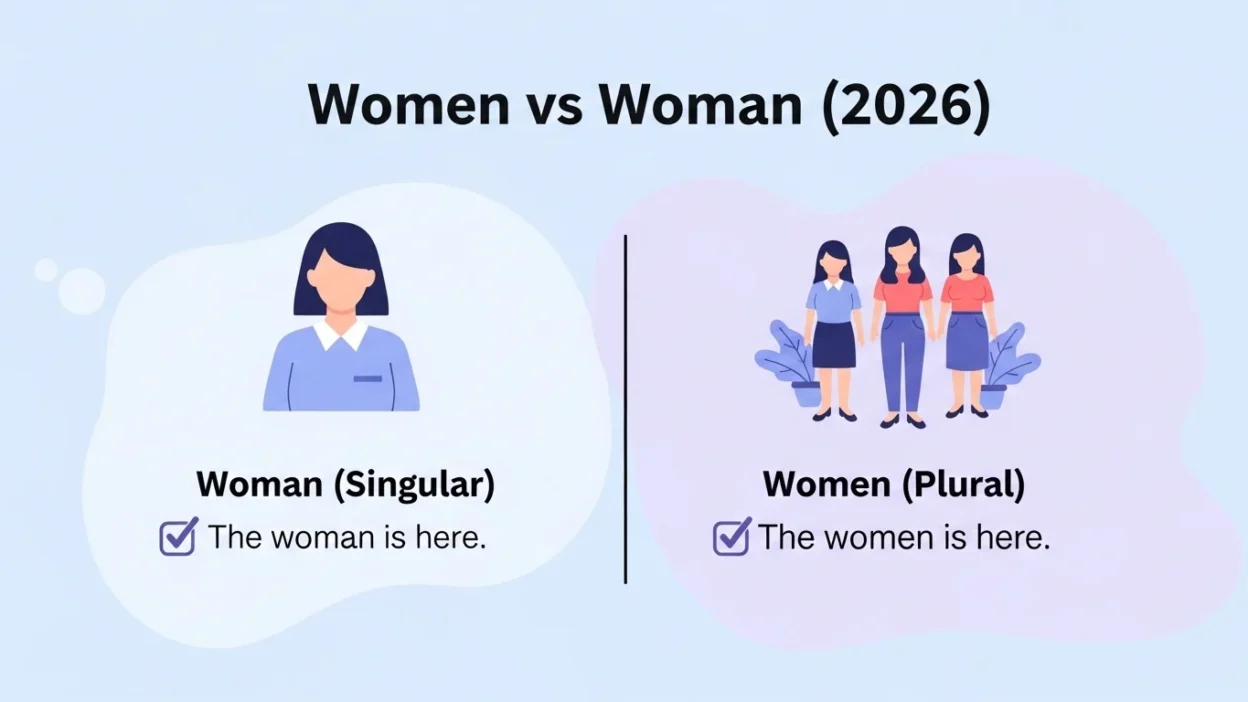
- Woman = one adult female person (singular)
- Women = more than one adult female person (plural)
- Woman → uses singular verbs (is, was, has)
- Women → uses plural verbs (are, were, have)
- The plural form of woman is women (not womans)
If you remember this rule, you already understand the main difference.
Simple Background: Why Does the Spelling Change?
In English, most words form plurals by adding “s”:
- Book → Books
- Teacher → Teachers
But some words are irregular.
Examples:
- Man → Men
- Woman → Women
- Foot → Feet
- Tooth → Teeth
Notice something important:
The vowel sound changes.
This happens because of old English language patterns. That is why we say:
- Woman → Women
- Not: Womans ❌
Understanding this helps you remember the singular and plural of woman more easily.
Clear Explanation: Woman vs Women Meaning
What Is “Woman”?
“Woman” means one adult female person.
Examples:
- A woman is waiting outside.
- The woman is my doctor.
- One woman called you.
If you ask, “Is woman singular or plural?”
The answer is: Woman is singular.
What Is “Women”?
“Women” means more than one adult female person.
Examples:
- Many women work here.
- The women are talking.
- Two women entered the room.
If you ask, “Is women singular or plural?”
The answer is: Women is plural.
That is the core difference between woman and women.
Pronunciation: Why Do They Sound Different?
This is where many learners struggle.
Woman
Sound: /ˈwʊmən/
Sounds like: wuh-muhn
Women
Sound: /ˈwɪmɪn/
Sounds like: wi-min
Notice:
- The first vowel changes.
- The second syllable is soft in both words.
Practice Saying:
- One woman
- Two women
- The woman is here
- The women are here
Say them slowly and clearly.
Memory trick:
Woman has “a” → one person
Women has “e” → extra people
Woman vs Women Comparison Table
| Feature | Woman | Women |
| Meaning | One adult female | More than one adult female |
| Number | Singular | Plural |
| Verb | is / was / has | are / were / have |
| Example | The woman is here. | The women are here. |
| With Numbers | One woman | Two women |
| With Many | ❌ Many woman | ✅ Many women |
This makes woman vs women in a sentence easier to understand.
When to Use Woman or Women
Use “Woman” When:
- Talking about one person
- Using “a” or “one”
- The verb is singular
Examples:
- A woman is calling you.
- One woman won the prize.
- The woman was happy.
Use “Women” When:
- Talking about two or more people
- Using words like many, several, two, three
- The verb is plural
Examples:
- Many women attended.
- Two women are outside.
- The women were excited.
Always count the number first.
Important Section: Woman vs Women vs Women’s
Many learners also confuse possessive forms.
Woman’s (Singular Possessive)
Means something belongs to one woman.
- The woman’s bag is on the table.
- That is the woman’s car.
Women’s (Plural Possessive)
Means something belongs to multiple women.
- The women’s room is upstairs.
- Women’s rights are important.
Common Mistake
❌ Womens clothing
✅ Women’s clothing
Always add apostrophe + s for possession.
This clears another common mistake in woman vs women grammar.
Woman vs Girl vs Lady (Quick Clarification)
Some learners also ask about related words.
- Girl → young female
- Woman → adult female
- Lady → polite or respectful way to say woman
Example:
- The girl is 10 years old.
- The woman is 30 years old.
This helps avoid vocabulary confusion.
Common Mistakes People Make
1. Adding “S”
❌ Womans
✅ Women
2. Wrong Verb
❌ The women is here.
✅ The women are here.
3. Using Woman for Plural
❌ Many woman work here.
✅ Many women work here.
4. Forgetting the Apostrophe
❌ Womens rights
✅ Women’s rights
Everyday Real Life Examples
In Emails
- A woman from HR contacted me.
- The women in the office shared ideas.
In News
- A woman won the competition.
- Women are leading new projects.
On Social Media
- That woman inspires me.
- Strong women support each other.
At School
- The woman is our new principal.
- The women teachers organized the event.
Real-life examples help you remember how to use woman and women correctly.
Mini Learning Section for Students
Step 1: Count
One? → Woman
More than one? → Women
Step 2: Check the Verb
Woman → is
Women → are
Step 3: Quick Drill
Choose the correct word:
- One ______ applied.
- Many ______ attended.
- The ______ is my teacher.
- The ______ are ready.
Answers:
- woman
- women
- woman
- women
Practice like this daily.
Memory Tricks
- Woman = A → Alone (one person)
- Women = E → Extra people
- Man → Men
- Woman → Women
If you remember “man to men,” you can remember “woman to women.”
FAQ Section
1. What is the difference between woman and women?
Woman means one adult female. Women means more than one.
2. What is the plural form of woman?
The plural form of woman is women.
3. Why is women pronounced differently?
Because English changes vowel sounds in some irregular plural words like man/men and woman/women.
4. Is woman singular or plural?
Woman is singular.
5. Is women always plural?
Yes. Women is always plural.
6. When do I use women’s?
Use women’s when something belongs to multiple women.
Example:
- Women’s clothing
7. Can I say “one women”?
No.
Correct: One woman.
8. Why isn’t it “womans”?
Because woman is an irregular noun. Its plural form changes spelling to women.
Conclusion
The difference between women vs woman is simple when you break it down:
- Woman = one adult female
- Women = more than one adult female
- Woman → is
- Women → are
- Woman’s = belongs to one
- Women’s = belongs to many
Count the number. Check the verb. Listen to the pronunciation.
Now you can confidently use woman and women correctly in school, writing, speaking, emails, and daily life without confusion.