Many students, learners, and beginners get confused between unconsolable vs inconsolable. Both words sound alike and are about sadness, but they are not exactly the same.
In this article, you will learn the difference between unconsolable and inconsolable, how to use them correctly, and see easy examples you can remember.
Why People Get Confused
People often mix up unconsolable and inconsolable because:
- They look almost the same.
- They sound very similar.
- Both describe someone who cannot be comforted.
Even dictionaries list similar meanings, but knowing the inconsolable vs unconsolable difference can help you write and speak correctly.
Quick Answer: Inconsolable vs Unconsolable
Here’s a fast, easy guide:
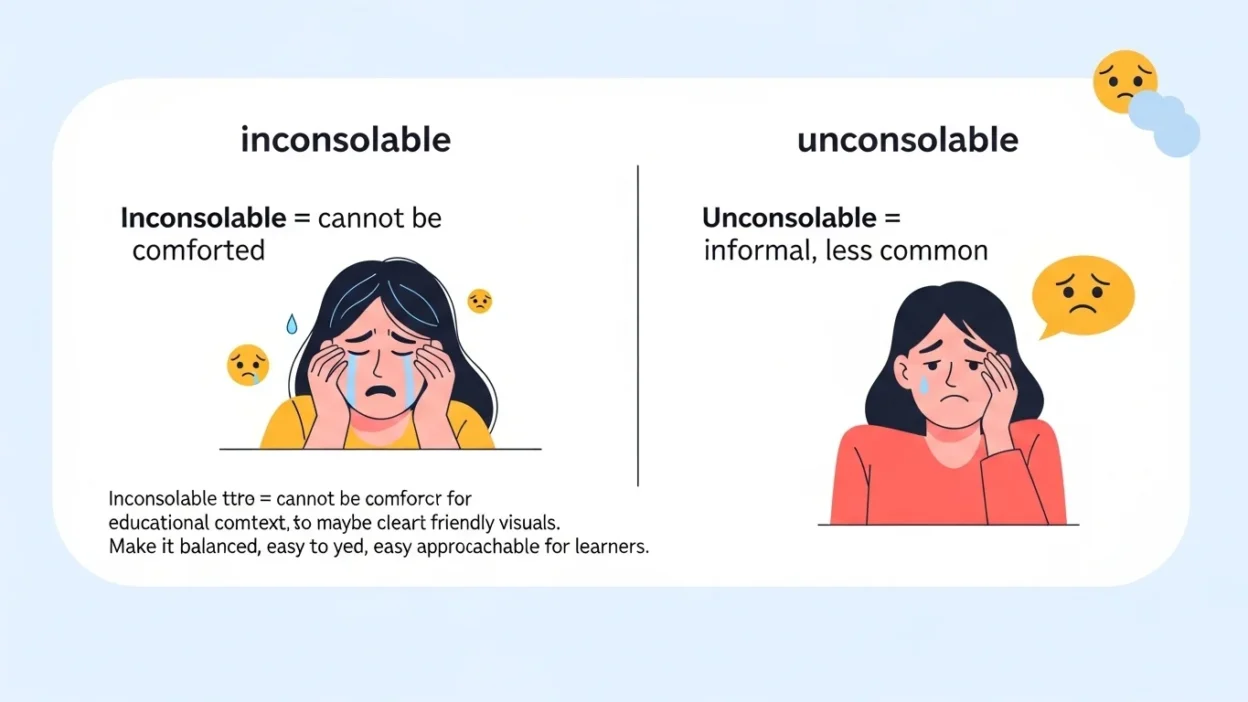
- Inconsolable ✅ → Extremely sad; cannot be comforted. (Correct for writing and speaking)
- Unconsolable ⚠️ → Sometimes used the same as inconsolable, but less common and informal.
- Tip: When in doubt, always use inconsolable.
Pronunciation:
- Inconsolable → /ɪnˈkɒnsələbl/ → in-CON-so-luh-bul
- Unconsolable → /ʌnˈkɒnsələbl/ → un-CON-so-luh-bul
Origins of the Words
Understanding origins helps remember the difference:
- Inconsolable comes from Latin:
- in- = not
- consolari = to comfort
→ Meaning: cannot be comforted
- in- = not
- Unconsolable comes from English:
- un- = not
- consolable = able to be comforted
→ Meaning: not able to be comforted
- un- = not
✅ Both words mean almost the same, but inconsolable is the standard, correct choice.
Clear Explanation of the Difference
| Feature | Inconsolable | Unconsolable |
| Meaning | Cannot be comforted | Cannot be comforted |
| Correctness | ✅ Standard English | ⚠️ Informal, less common |
| Writing & Speaking | Always safe | Use only in casual speech |
| Common contexts | Sadness, grief, loss, disappointment | Same but informal |
| Example | She was inconsolable after hearing the news. | He seemed unconsolable, crying in his room. |
Tip: Think “in-CON-so-lable → cannot be comforted → correct.”
When to Use Which Word
- Inconsolable → For school essays, emails, news articles, or professional writing.
- Unconsolable → Only in casual speech, storytelling, or informal texts.
Quick Memory Trick:
- In = correct, safe
- Un = informal, less common
Common Mistakes
- Using unconsolable in formal writing.
- Mixing inconsolable and unconsolable in the same sentence.
- Forgetting pronunciation differences.
- Not giving enough context in examples (confuses ESL learners).
Everyday Real Life Examples
Here are easy examples for unconsolable vs inconsolable sentences in daily life:
1. Emails
- ✅ “She was inconsolable after missing the meeting.”
- ⚠️ “He looked unconsolable when he read your email.”
2. News Headlines
- ✅ “Family inconsolable after tragedy strikes.”
- ⚠️ “Fans unconsolable after team loses championship.”
3. Social Media
- ✅ “I’m inconsolable 😢 my phone broke today!”
- ⚠️ “He’s unconsolable over that movie ending 😭”
4. Classroom Examples
- Teacher: “Why is Sara crying?”
Student: “She’s inconsolable because she lost her homework.” ✅ - Student: “He’s unconsolable about the test.” ⚠️ (informal)
5. Movies / Storytelling
- ✅ “The hero was inconsolable after his friend left.”
- ⚠️ “The villain seemed unconsolable after losing the battle.”
Short Learning Section for Students
Remember the rules easily:
- Inconsolable = correct / standard
- Unconsolable = informal / less common
Practice Sentences:
- After the exam results, Maria was inconsolable.
- He became inconsolable when his dog ran away.
- The little boy was inconsolable after losing his toy.
Mini Tip:
- Highlight “in-CON-so-lable” → always correct
- Use emojis 😢😭 in examples to remember emotion
FAQs: Inconsolable vs Unconsolable
1. Can I use unconsolable instead of inconsolable?
Yes, in casual speech. But in writing, always use inconsolable.
2. Do unconsolable and inconsolable mean the same?
Almost the same, but inconsolable is correct in standard English.
3. Why do people use unconsolable?
It is an informal version or a natural speech mistake.
4. Is unconsolable wrong?
Not in casual conversation, but it is nonstandard in writing.
5. Can a person be inconsolable for a short time?
Yes, even a few minutes of extreme sadness counts.
6. Are these words only for sadness?
Mostly for sadness, grief, or strong disappointment.
7. How can I remember the correct word?
Think “in = cannot be comforted → correct.”
8. Can animals be inconsolable?
Yes, pets can be inconsolable after loss or stress.
Conclusion
- Inconsolable = safe, standard, correct → cannot be comforted.
- Unconsolable = informal, less common, sometimes wrong.
- Use inconsolable in writing, emails, essays, and formal situations.
- Remember: “in-consolable → correct → cannot be comforted.”
With this guide, you can confidently use unconsolable vs inconsolable correctly in speech and writing, and remember pronunciation, meaning, and examples easily!