English can be tricky. Some words look or sound similar, but they have very different meanings.
One pair that confuses many learners is “to bad vs too bad.” People often make mistakes in writing or speaking.
This guide will explain the difference between too bad and to bad clearly, give examples, and help you use them correctly every time.
Why People Get Confused
- Pronunciation: “Too” and “to” sound almost the same.
- Spelling mistakes: Learners often write to bad instead of too bad.
- Grammar misunderstanding: “Too” can mean “also” or “very,” and beginners forget it in this phrase.
Understanding too bad meaning is simple once you know the rules.
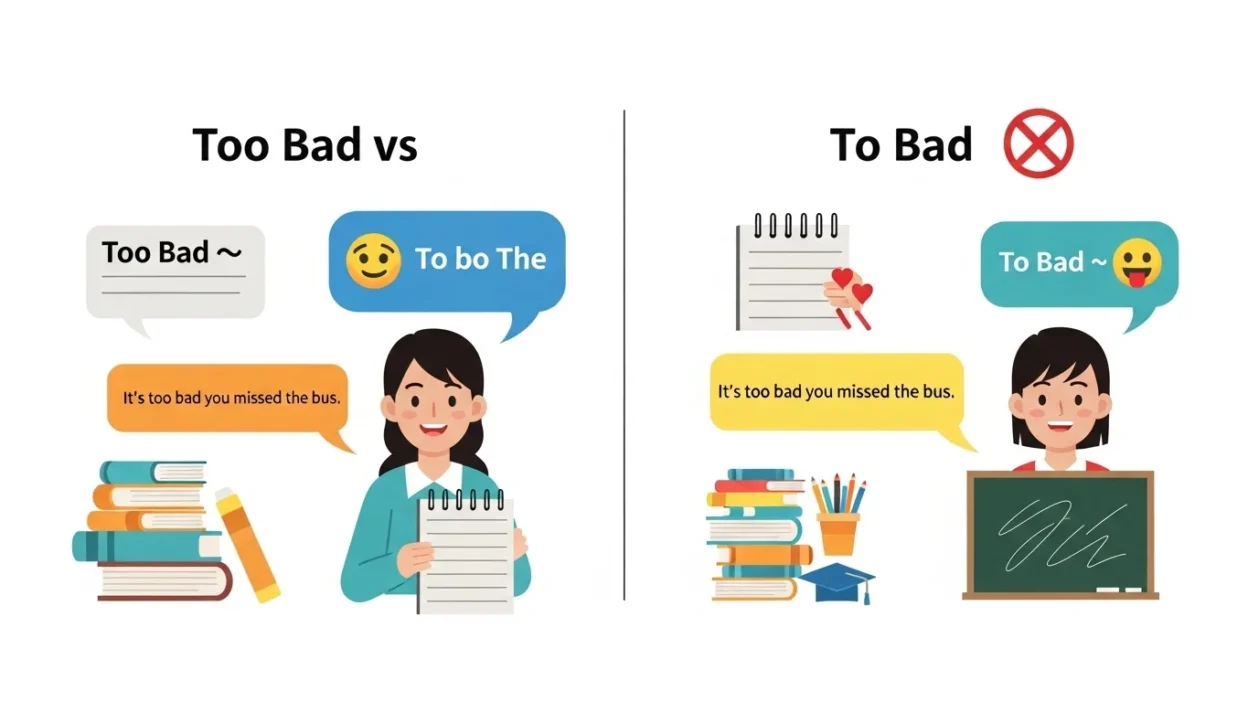
Quick Answer: To Bad vs Too Bad
- Too bad ✅ – Correct spelling. It means something is unfortunate or disappointing.
- Example: “It’s too bad you missed the party.”
- Example: “It’s too bad you missed the party.”
- To bad ❌ – Incorrect. Never use it in writing or speech.
Tip: If you want to show sympathy or disappointment, always use too bad.
Definition of Too Bad
Too bad (adjective phrase): used to show that something is unfortunate, disappointing, or unlucky.
- Structure: too + adjective
- Meaning: very unfortunate
Example sentences:
- “It’s too bad that the game was canceled.”
- “Too bad! I was looking forward to it.”
Difference Between Too Bad and To Bad
| Feature | Too Bad ✅ | To Bad ❌ |
| Correct or Incorrect | Correct | Incorrect |
| Meaning | Unfortunate, disappointing | None |
| Example | “It’s too bad you failed the test.” | “It’s to bad you failed the test.” (wrong) |
| Used in | Conversation, emails, social media | Never |
| Pronunciation | /tuː bæd/ | /tuː bæd/ (sounds same, spelling wrong) |
Key point: Always use too bad to express disappointment.
How to Use Too Bad: Sentence Patterns
Here are simple patterns for students and ESL learners:
| Pattern | Example |
| It’s too bad + clause | “It’s too bad that you missed the bus.” |
| Too bad + simple statement | “Too bad! I can’t believe it.” |
| Too bad + reason | “Too bad you didn’t bring your homework, otherwise you could join the project.” |
Common Mistakes
| Mistake | Correct Version | Note |
| to bad | too bad | Most common spelling mistake |
| 2 bad | too bad | Numbers are never used |
| so bad (meaning disappointment) | too bad | “So bad” usually means poor quality |
| Forgetting “too” | too bad | Always remember the double “o” |
Related Expressions for “Too Bad”
Sometimes you can use other ways to show disappointment:
- What a shame – “What a shame you can’t come.”
- Unfortunately – Formal alternative, good for emails or reports.
- “Unfortunately, the event was canceled.”
- “Unfortunately, the event was canceled.”
- That’s too bad – Polite, conversational:
- “You lost your wallet?” → “That’s too bad!”
- “You lost your wallet?” → “That’s too bad!”
Tip: “Too bad” is informal; in formal writing, prefer unfortunately.
Everyday Real Life Examples
Emails:
- “Too bad you couldn’t attend the meeting. We will send the notes.”
Social Media:
- “Missed the concert 😢 too bad!”
News:
- “It’s too bad that the festival was canceled due to rain.”
Daily Conversation:
- Friend 1: “I lost my wallet.”
- Friend 2: “Too bad! I hope you find it soon.”
Text Message:
- “Can’t join dinner tonight? Too bad 😔”
Notice how naturally too bad fits in conversation, emails, and posts.
Learning Tips for Students and Beginners
- Think “too = very”
- Too bad = very bad/unfortunate
- Too bad = very bad/unfortunate
- Say it out loud
- “Too bad” → /tuː bæd/
- “Too bad” → /tuː bæd/
- Practice examples
- “It’s too bad I can’t go.”
- “Too bad it’s raining.”
- “It’s too bad I can’t go.”
- Check your writing
- Look for to bad and correct it to too bad
- Look for to bad and correct it to too bad
FAQ: To Bad vs Too Bad
1. Can I say “to bad” in speech?
- No, it is always incorrect. Use too bad.
2. What does “too bad” mean?
- It shows something is unfortunate or disappointing.
3. Is “too bad” formal or informal?
- Informal but polite. For formal writing, use unfortunately.
4. Can I use “so bad” instead of “too bad”?
- Not for disappointment. “So bad” usually means poor quality.
5. Can “too bad” describe people?
- Usually no, it describes situations, not people.
6. Can I write “2 bad”?
- No. Always use too bad.
7. Can I use it in emails?
- Yes, but informal emails only. For formal emails, write: “Unfortunately, you missed the meeting.”
8. Is “too bad” used in British and American English?
- Yes, both varieties use it commonly.
Conclusion
English spelling and expressions can be tricky, but too bad vs to bad is easy once you know the rules.
- ✅ Too bad – correct, shows disappointment
- ❌ To bad – incorrect, never use it
Remember: “too = very”. Use the tables, patterns, and examples above to practice. Next time something unfortunate happens, just say:
“Too bad!”
It’s simple, correct, and perfect for conversation, emails, or social media.