English can be tricky. Words that sound almost the same can have very different meanings. One example is take effect vs take affect.
Many students, learners and beginners get confused because these phrases sound alike, but only take effect is correct in most situations.
In this guide, you will learn:
- The difference between take effect and take affect
- Take effect meaning and correct usage
- Common mistakes to avoid
- practical examples for everyday English
- Quick exercises and tips to remember
By the end, you’ll never mix them up again.
Quick Answer: Take Effect vs Take Affect
Here’s the simplest way to remember:
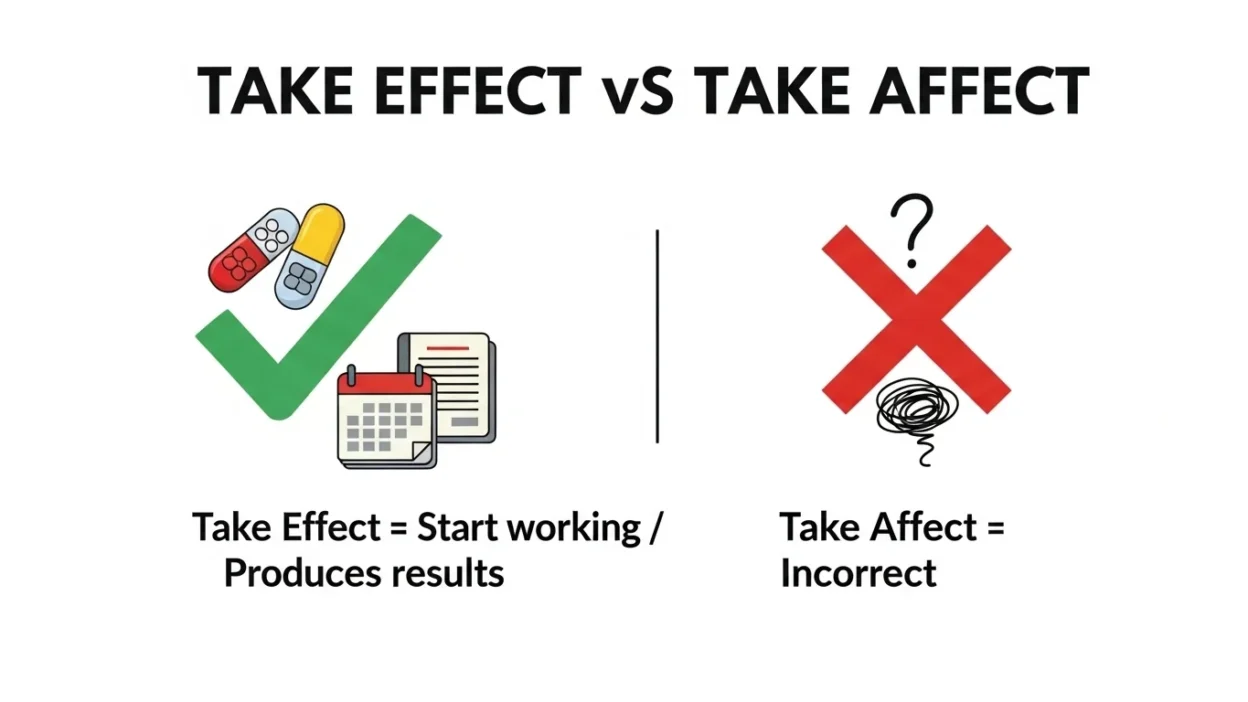
- Take effect ✅ – Correct. Means: to start working, to produce results.
- Take affect ❌ – Incorrect. This is almost always a mistake.
Memory trick:
- Effect = result → Take effect = something starts giving results
- Affect = influence → Do not use “take affect”
Origin / Background
- Effect is a noun. It means the outcome or result of an action.
- Affect is usually a verb. It means to influence or change something.
Confusion happens because effect and affect sound similar, especially in speech.
Example:
- The new law takes effect on Monday. ✅ (result)
- The new law affects students’ daily routine. ✅ (influence)
Clear Explanation of the Difference
1. Take Effect
- Meaning: To start working or produce results
- Grammar: Correct combination of verb + noun
- Examples:
- The medicine will take effect in 30 minutes.
- The new rules take effect tomorrow.
- Your changes will take effect after you save the document.
- The medicine will take effect in 30 minutes.
2. Take Affect
- Meaning: Incorrect. This phrase is not standard English
- Common mistake: People confuse it with “take effect” because it sounds similar
- Tip: If you mean something starts working or producing results, use take effect
Comparison Table
| Phrase | Correct? | Meaning | Example Sentence |
| Take effect | ✅ Yes | Start producing results | The new rules take effect tomorrow. |
| Take affect | ❌ No | Incorrect | ✖ The new rules will take affect tomorrow. |
When to Use Take Effect
- Use it for: laws, rules, medicines, changes, plans, or actions
- Do not use take affect
- Memory tip: Effect = Result → Take effect = Result starts
Example sentences for daily use:
- The new traffic rules will take effect next week.
- The teacher said the homework policy takes effect today.
- Your password change will take effect immediately.
- The medicine finally took effect after 20 minutes.
Common Mistakes to Avoid
- Writing take affect instead of take effect.
- Using take effect for emotions (use affect for influence).
- Confusing effect vs affect in English.
Quick correction tip:
- Effect = result → Take effect
- Affect = influence → The new rule affects students
Everyday Examples (Emails, Social Media, News)
Emails:
- The new vacation policy will take effect on March 1st.
- Please note that changes to the schedule take effect immediately.
Social Media:
- Our updated app features will take effect from today!
- The new safety measures take effect next week.
News Headlines:
- The new tax laws take effect in January.
- Mask rules take effect tomorrow.
Daily Life / Spoken English:
- The medicine I took finally took effect.
- The new gym timings take effect from Monday.
practice sentences: (some examples for exercises)
- The new school uniform policy will ____ next Monday. → take effect
- Your password change will ____ immediately. → take effect
- The law will ____ next year. → take effect
- The medicine didn’t ____ until after lunch. → take effect
- The new classroom rules ____ from today. → take effect
Learning Section for Students and Beginners
Simple steps to remember:
- Effect = Result → Take effect = something starts giving results
- Affect = Influence → Do not use take affect
Mini exercise: Fill in the blanks with take effect or affect:
- The new schedule will ____ on Monday.
- The weather can ____ our mood.
- Your changes will ____ after saving the document.
- The new law will ____ students’ daily routine.
Answers: 1. take effect, 2. affect, 3. take effect, 4. affect
FAQ Section
1. Can I ever use take affect?
No. It is always incorrect. Always use take effect.
2. Why do people confuse take effect and take affect?
Because “effect” and “affect” sound almost the same.
3. Is affect ever a noun?
Yes, mainly in psychology. In daily English, affect is usually a verb.
4. Can I say “The law will take effect”?
Yes! This is correct.
5. What is the easiest way to remember take effect meaning?
Effect = result → Take effect = result starts.
6. Can take effect be used for feelings?
No. Use affect if you mean influence or emotions.
7. Can I say “The change will take affect soon”?
No, this is incorrect. Correct: The change will take effect soon.
Conclusion
“Take effect vs take affect” is a common English confusion. Only take effect is correct. It means “to start working or produce results.”
Remember:
- Effect = Result → Take effect = result starts
- Affect = Influence → Do not use take affect
By reading, practicing examples, and using mini exercises, beginners and learners can master this rule easily and confidently use take effect in everyday English.