Many people get confused between Segway and Segue. They sound almost the same when spoken, but they mean very different things.
Even native speakers sometimes mix them up! This article explains Segway meaning, Segue meaning, the difference between Segway and Segue, and how to use them correctly with examples, tricks, and practice.
Why People Get Confused
- Both words sound very similar: Segway vs Segue.
- One is a brand name for a scooter, the other is a transition word.
- Spelling is different from how it sounds.
- Using the wrong word can make your sentence confusing.
Tip: By the end of this article, you’ll never mix up Segway or Segue again.
Quick Answer: Segway vs Segue
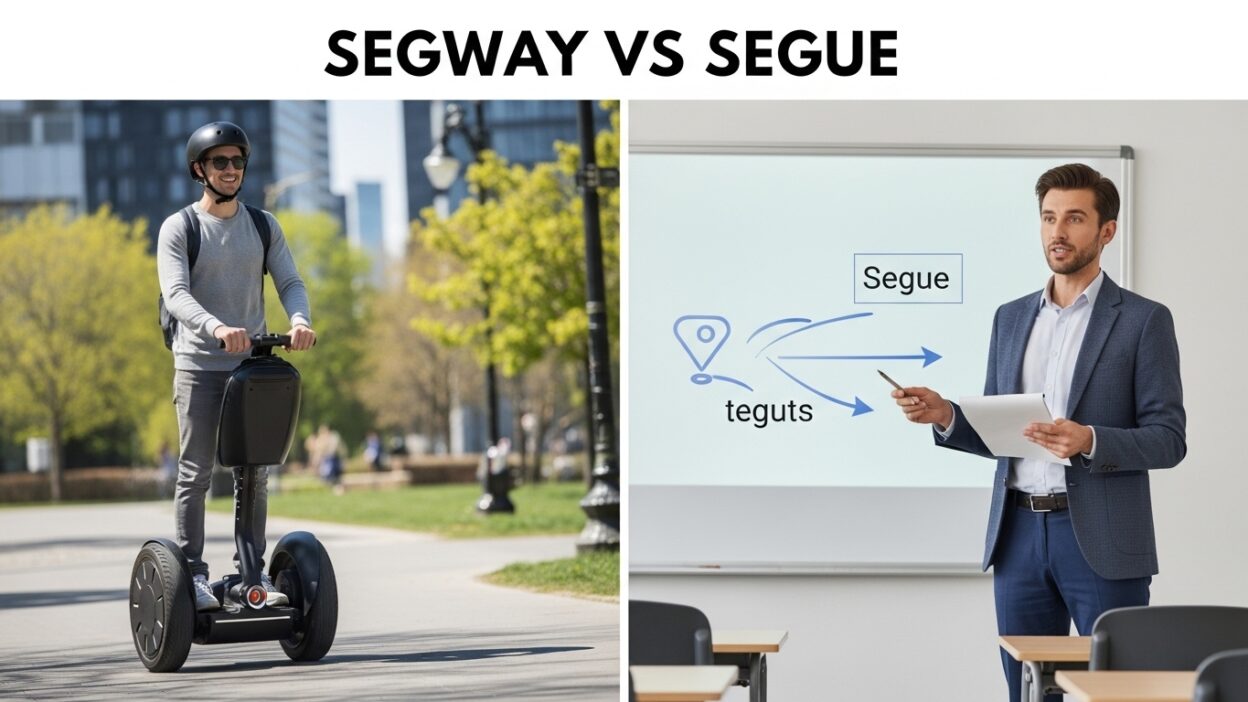
- Segway: A self-balancing Segway scooter.
- Example: “I rode my Segway in the park.”
- Example: “I rode my Segway in the park.”
- Segue: A smooth segue transition from one topic to another.
- Example: “Let’s segue to the next topic in the meeting.”
- Example: “Let’s segue to the next topic in the meeting.”
Remember:
- Movement on wheels → Segway
- Movement between ideas → Segue
Origins of Segway and Segue
Segway
- Invented in 2001 by Dean Kamen.
- Brand name for a two-wheeled, self-balancing scooter.
- Pronounced /ˈsɛɡ.weɪ/.
- Often used in tourism, parks, and police patrols.
Segue
- Comes from Italian, meaning “it follows”.
- Used in English since the 1900s.
- Pronounced /ˈsɛɡ.weɪ/ (same as Segway).
- Common in writing, music, or speech for smooth transitions.
Mnemonic trick:
- Segway = scooter (vehicle) → think of wheels.
- Segue = smooth transition → think of arrows moving from one topic to another.
Segway vs Segue: Side-by-Side Comparison
| Feature | Segway | Segue |
| Meaning | A type of Segway scooter | A smooth segue transition between topics |
| Part of Speech | Noun | Verb or noun |
| Origin | Brand name (modern invention) | Italian word (language origin) |
| Pronunciation | /ˈsɛɡ.weɪ/ | /ˈsɛɡ.weɪ/ |
| Usage | Vehicles, riding, parks | Writing, speech, presentations, music |
| Capitalization | Always capitalized (brand) | Usually lowercase |
When to Use Segway or Segue
- Use Segway: Talking about scooters or riding.
- Example: “We rented a Segway scooter to explore the city.”
- Example: “We rented a Segway scooter to explore the city.”
- Use Segue: Talking about a smooth change from one topic to another.
- Example: “The teacher made a perfect segue from grammar to vocabulary.”
- Example: “The teacher made a perfect segue from grammar to vocabulary.”
Quick tip: Think Segway = wheels, Segue = ideas.
Common Mistakes
- Using Segway instead of Segue:
- ❌ “Let’s Segway to the next topic.”
- ✅ “Let’s segue to the next topic.”
- ❌ “Let’s Segway to the next topic.”
- Thinking Segue is a vehicle:
- ❌ “I bought a new segue for fun.”
- ✅ “I bought a new Segway for fun.”
- ❌ “I bought a new segue for fun.”
- Forgetting capitalization:
- Brand names like Segway must always be capitalized.
- Brand names like Segway must always be capitalized.
- Pronunciation confusion is common, but spelling is crucial in writing.
Everyday Real Life Examples
In Emails
- ❌ “We will Segway to the next topic tomorrow.”
- ✅ “We will segue to the next topic tomorrow.”
In News
- “The police used Segways to patrol the park.” ✅
On Social Media
- “She made a smooth segue transition from one video to another.” ✅
In Daily Conversation
- “I rented a Segway scooter at the amusement park.” ✅
- “During the lecture, the teacher made a quick segue to homework.” ✅
Fun Practice for Students & Beginners
Fill in the blanks:
- I rode my ___ in the city park. (Segway)
- The speaker made a smooth ___ to the next subject. (segue)
- My friend bought a ___ yesterday. (Segway)
- Let’s ___ from history to science. (segue)
Try making your own sentences using Segway and Segue.
Extra Learning Tips
- Pronunciation trick: Say both words slowly: Seg-way. Imagine the scooter moving for Segway, imagine a line connecting topics for Segue.
- Memory association: Wheels → Segway; Ideas → Segue.
- Mini story: “I rode my Segway scooter to school. Then the teacher made a smooth segue from math to English.”
FAQ Section
1. Are Segway and segue pronounced the same?
Yes, both are pronounced /ˈsɛɡ.weɪ/.
2. Can Segue be a noun?
Yes, e.g., “That was a perfect segue transition in the class.”
3. Can Segway be used as a verb?
No, Segway is only a noun (the scooter).
4. Is Segue only for writing?
No, it’s used in speech, music, presentations, and writing.
5. Are there similar words to segue?
Yes, words like transition, shift, or link are similar.
6. Do I always capitalize Segway?
Yes, because it is a brand name. Segue is usually lowercase.
7. Can I say “I segwayed to the next topic”?
No, always use segue when talking about topic changes.
8. Why do people confuse them?
They sound the same, and the spelling is tricky, but practice makes it easy.
Conclusion
Segway and Segue sound the same but have very different meanings. One is a Segway scooter for riding, the other is a smooth segue transition between topics. By using mnemonics, examples, and practice exercises, you can remember the difference easily.
Next time you speak or write, you’ll never mix up Segway or Segue again!