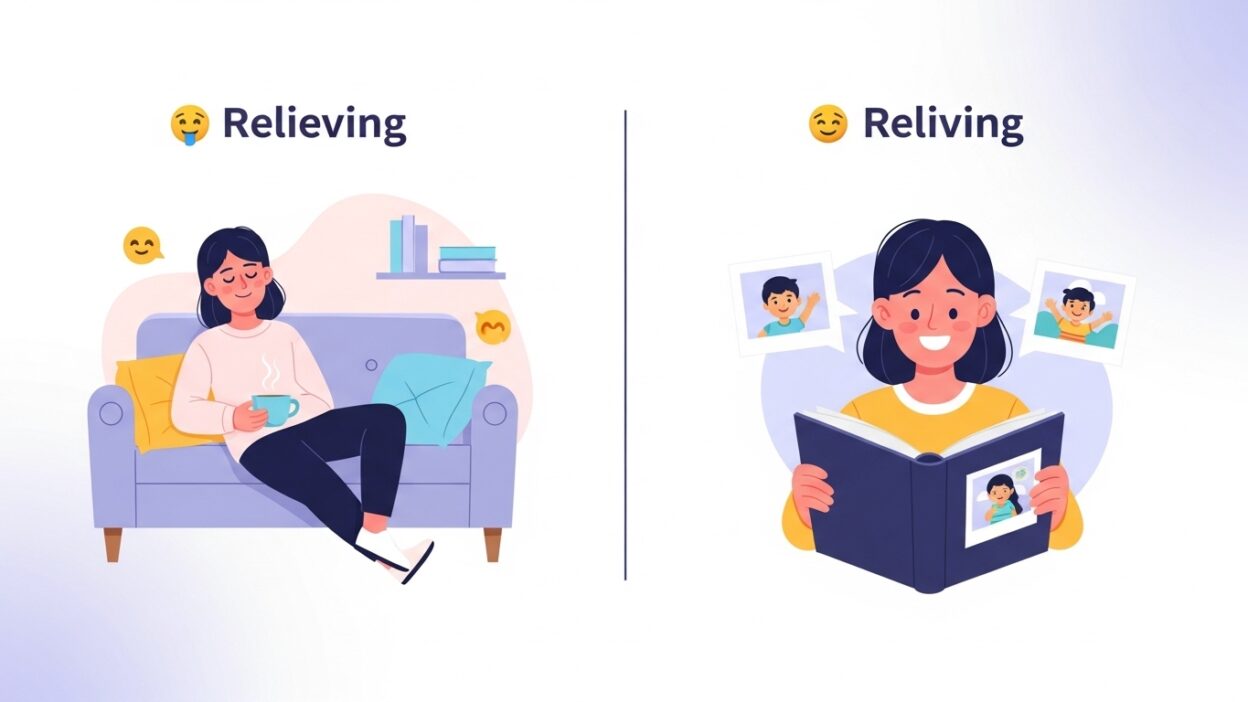
Many people, including students and learners, often get confused between relieving vs reliving. They look similar, sound alike, but have very different meanings.
Understanding the difference between relieving and reliving will help you write, speak, and read English confidently.
In this article, you will learn the relieving meaning, reliving meaning, common mistakes, everyday examples, and easy tips to remember the difference forever.
Why People Get Confused
- Both words start with “re” and end with “-ing.”
- They sound almost the same in speech.
- People hear them but often guess their meaning incorrectly.
- Using the wrong word changes your sentence completely.
Tip for beginners: If it’s about removing stress or pain, it’s relieving. If it’s about experiencing a memory again, it’s reliving.
Quick Answer: Relieving vs Reliving
- Relieving → taking away stress, pain, or problems.
- Reliving → experiencing something again in your mind or memory.
Simple bullet points:
- Relieving = removing or easing something difficult
- Reliving = experiencing again in your mind
- Both are action words because they end with -ing
Relieving Meaning
Relieving comes from the verb relieve, which means to make something easier or reduce stress or pain.
- Examples:
- “Taking a warm bath is relieving.”
- “Finishing my homework early was very relieving.”
- “Taking a warm bath is relieving.”
Tip to remember: Think “relieving = removing stress or pain”.
Reliving Meaning
Reliving comes from the verb relive, which means to experience something again in your mind.
- Examples:
- “Looking at old photos makes me relive my childhood.”
- “Watching the movie again helped me relive my first trip to Paris.”
- “Looking at old photos makes me relive my childhood.”
Tip to remember: Think “reliving = experiencing again”.
Comparison Table: Relieving vs Reliving
| Feature | Relieving | Reliving |
| Meaning | To take away pain or stress | To experience again |
| Root verb | Relieve | Relive |
| Example sentence | “This medicine is relieving.” | “I keep reliving that moment.” |
| Feeling | Comfort, ease | Memory, nostalgia, repetition |
| Common use | Health, stress, emotions, work | Memories, stories, past experiences |
When to Use Relieving and Reliving
Use “relieving” when:
- You want to say something makes life easier
- Talking about stress, pain, or problems
- Examples:
- “Meditation is very relieving.”
- “Finishing my assignment early is relieving.”
- “Meditation is very relieving.”
Use “reliving” when:
- Talking about memories or experiences again
- Referring to past events in your mind
- Examples:
- “Scrolling through old messages makes me relive last year’s trip.”
- “Reading childhood stories helps me relive happy moments.”
- “Scrolling through old messages makes me relive last year’s trip.”
Common Mistakes People Make
- Saying “reliving stress” instead of “relieving stress”
- Saying “relieving a memory” instead of “reliving a memory”
- Confusing the two because they look and sound similar
Memory trick:
- Relieving = remove
- Reliving = remember again
Everyday Real Life Examples
Emails:
- Correct: “I hope this guide is relieving for your study stress.”
- Correct: “Reading old emails makes me relive our last project.”
Social Media / Captions:
- “Yoga is so relieving after a long day!”
- “Watching old vacation videos makes me relive those memories ❤️.”
Mini Dialogues:
- A: “This headache is killing me!”
- B: “Take some medicine; it’s relieving.”
- A: “Remember our school trip?”
- B: “Yes! Looking at those photos makes me relive it.”
Short Learning Section for Students and Beginners
- Tip 1: “Relieving = removing stress or pain.”
- Tip 2: “Reliving = experiencing a memory again.”
- Tip 3: One idea per sentence; check your meaning.
- Tip 4: Practice simple sentences:
- “Listening to music is relieving.”
- “I relive my birthday party every time I see the pictures.”
- “Listening to music is relieving.”
Visual Cue:
- Relieving = 😌 (calm face)
- Reliving = 🕰️ (time/memory)
FAQ: Relieving vs Reliving
1. Can I say “reliving stress”?
No. Stress is relieved, not relived.
2. Can reliving be good or bad?
Yes. You can relive happy memories or relive bad experiences.
3. Is relieving only for physical pain?
No. It can also reduce mental or emotional stress.
4. Can I say “relieving memories”?
No. Memories are relived, not relieved.
5. Are these words common in English?
Yes. Both are widely used in everyday speech, writing, and social media.
6. How do I remember them easily?
- Relieving = remove stress
- Reliving = experience again
7. Can reliving be used for future events?
No. Reliving only refers to past experiences.
8. Can both words appear in the same sentence?
Yes: “Meditation is relieving, while looking at old photos is reliving.”
9. Any tips for pronunciation?
- Relieving → /rɪˈliːvɪŋ/ (stress on -leev)
- Reliving → /riːˈlɪvɪŋ/ (stress on -liv)
10. Common collocations:
- Relieving stress, pain, tension, workload
- Reliving memories, moments, experiences, stories
Conclusion
Understanding relieving vs reliving is simple if you remember:
- Relieving = removing stress or pain
- Reliving = experiencing past events or memories again
Use these tips, examples, and mnemonics to remember the difference instantly.
Next time you write, speak, or read English, you’ll confidently choose the right word!