Many students, learners and beginners often mix up peaceful vs harmless. Both words sound calm and safe, but they have very different meanings. Using the wrong one can make your sentence confusing.
For example:
- “The cat is peaceful.” ✅ (It is calm.)
- “The cat is harmless.” ✅ (It will not hurt anyone.)
In this article, you will learn the difference between peaceful and harmless in simple English with clear examples, exercises, and tips.
Quick Answer: Peaceful vs Harmless
Here’s a fast way to remember the difference:
- Peaceful
- Meaning: calm, quiet, not violent
- Focus: feelings or atmosphere
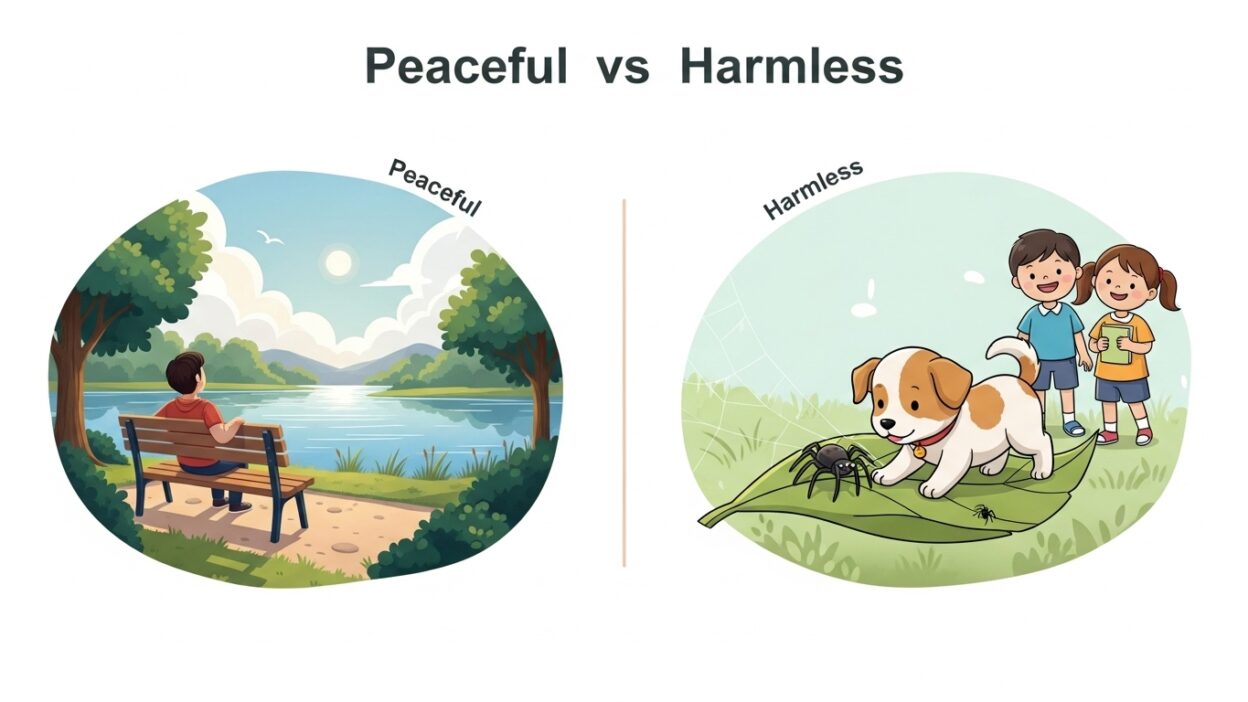
- Example: “The park is peaceful in the morning.”
- Meaning: calm, quiet, not violent
- Harmless
- Meaning: safe, will not hurt anyone or anything
- Focus: safety, danger
- Example: “The spider is harmless. It won’t bite you.”
- Meaning: safe, will not hurt anyone or anything
Tip for beginners: Ask yourself: Am I talking about calmness or safety? That will help you choose the right word.
Origins of the Words
- Peaceful comes from peace, meaning calm or no fighting. Adding -ful means “full of peace.”
- Harmless comes from harm, meaning danger or injury. Adding -less means “without harm,” so harmless means safe or not dangerous.
Main Difference Explained
| Word | Meaning | Focus |
| Peaceful | Calm, quiet, relaxed | Mood or atmosphere |
| Harmless | Safe, will not hurt | Safety and danger |
Example in real life:
- A peaceful dog sits quietly and doesn’t bark.
- A harmless dog may be playful but will not bite anyone.
Remember: peaceful = calm; harmless = safe.
When to Use Peaceful vs Harmless
- Peaceful – when describing calmness, quiet, or relaxation:
- “The lake looks peaceful at sunset.”
- “She has a peaceful mind after meditation.”
- “The lake looks peaceful at sunset.”
- Harmless – when describing safety or danger:
- “The jellyfish is harmless; it won’t sting.”
- “He is harmless; don’t worry about him.”
- “The jellyfish is harmless; it won’t sting.”
Common Mistakes to Avoid
- Wrong: “The dog is peaceful” (if you mean it won’t bite)
Right: “The dog is harmless.” - Wrong: “The movie is harmless” (if you mean calm or relaxing)
Right: “The movie is peaceful.” - Wrong: “Don’t worry, the class is harmless” (in emails or posts)
Right: “The class is peaceful.”
Everyday Real Life Examples
Emails:
- Peaceful: “I hope you have a peaceful weekend.”
- Harmless: “The virus is harmless, no need to panic.”
News Headlines:
- Peaceful: “Peaceful protest continues in the city.”
- Harmless: “Harmless insect found in the garden.”
Social Media:
- Peaceful: “Enjoying a peaceful morning with coffee ☕”
- Harmless: “This joke is harmless 😂”
Daily Life:
- Peaceful: “The evening walk was peaceful.”
- Harmless: “The puppy is small and harmless.”
Mini Dialogue Example:
- A: “Is that dog dangerous?”
- B: “No, it’s harmless, but not very peaceful—it keeps running around.”
Student Friendly Learning Section
Memory Tip:
- Peaceful = calm → Think of a quiet park or a calm mind.
- Harmless = safe → Think of a small puppy or a gentle insect.
Mini Exercises: Fill in the blanks:
- The forest is very _______ in winter.
- Don’t worry about the snake; it is _______.
- The classroom was _______ after the teacher left.
- The little frog is _______; it cannot hurt anyone.
Answers: 1. peaceful, 2. harmless, 3. peaceful, 4. harmless
Advanced Tip for Beginners
Some things can be both peaceful and harmless:
- Example: “The calm puppy sitting under the tree is peaceful and harmless.”
Some things are peaceful but not harmless:
- Example: “The calm river looks peaceful but it is dangerous to swim in.”
Some things are harmless but not peaceful:
- Example: “The playful puppy is harmless, but very noisy.”
This will help you understand real-life usage and avoid mistakes.
FAQ: Peaceful vs Harmless
1. Can a person be peaceful?
Yes. Example: “She is a peaceful person who never argues.”
2. Can a person be harmless?
Yes. Example: “He is harmless; don’t worry about his jokes.”
3. Can something be both peaceful and harmless?
Yes. Example: “A calm puppy in the park is both peaceful and harmless.”
4. Is peaceful the same as safe?
No. Peaceful is about calmness, not safety.
5. Is harmless the same as calm?
No. Harmless is about safety, not calmness.
6. Can harmless be used for ideas or words?
Yes. Example: “The comment was harmless; nobody got offended.”
7. Can peaceful be used for animals?
Yes. Example: “The dog is peaceful and sleeps all day.”
8. Are these words opposites?
No. They are different words: one is about calm, the other about safety.
Conclusion
To remember the difference between peaceful and harmless:
- Peaceful = calm and quiet → talks about mood or atmosphere
- Harmless = safe and not dangerous → talks about safety or danger
Think about whether you want to describe calmness or safety. Using the words correctly in daily life, emails, social media, and news will make your English clear and easy to understand.
Extra Tip: Try creating your own examples from your life. For instance, look around your home and write:
- “This place is peaceful.”
- “This object is harmless.”