Many learners of English, including students and learners, often confuse patient vs patience.
These words look similar and sound almost the same, but their meanings are very different. Using the wrong word can make your sentence confusing.
In this article, you will learn the difference between patient and patience, see clear examples, and get tips to remember them forever.
Quick Answer: Patient vs Patience
Here’s a simple guide:
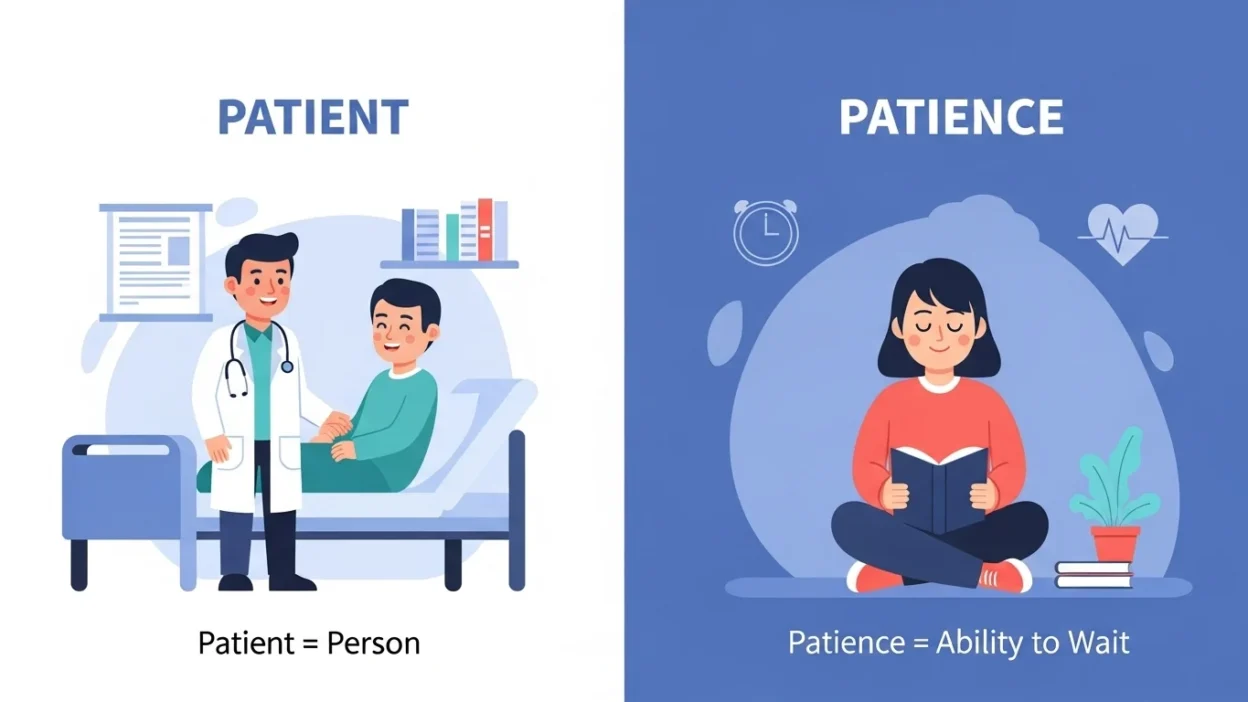
- Patient – A person receiving medical care, or someone who can wait calmly.
- Example: “The doctor helped the patient.”
- Example: “The doctor helped the patient.”
- Patience – The ability to wait calmly without anger or frustration.
- Example: “Learning English requires patience.”
- Example: “Learning English requires patience.”
Tip:
- Patient = person or calm adjective
- Patience = quality or skill
Pronunciation & Mnemonics
Pronunciation:
- Patient → /ˈpeɪ·ʃənt/
- Patience → /ˈpeɪ·ʃəns/
Memory Tricks:
- Patient has a person in it → P-A-T-I-E-N-T = person or calm adjective.
- Patience ends with -ence → think of “ability or skill” → patience = ability to wait.
Origin / Background
- Patient comes from Latin patiens (“suffering, enduring”) → person who endures illness or difficulty.
- Patience comes from the same root → means the skill of waiting calmly.
Even though the root is the same, one became a noun for a person and the other became a noun for a skill or feeling.
Clear Explanation of the Difference
| Word | Type | Meaning | Example |
| Patient | Noun | A person receiving medical care | “The patient is in the hospital.” |
| Patient | Adjective | Calm and able to wait | “Be patient with your homework.” |
| Patience | Noun | The ability to wait calmly or endure difficulties | “Learning English requires patience.” |
Tip:
- Talking about a person → patient
- Talking about the skill/ability → patience
More Examples of Patient as an Adjective
- “Be patient while I finish cooking.”
- “She is very patient with children.”
- “You need to be patient when learning a new skill.”
- “He stayed patient during the long meeting.”
- “Try to be patient in traffic jams.”
Comparison Table: Easy Scan
| Feature | Patient | Patience |
| Part of Speech | Noun / Adjective | Noun |
| Meaning | Person receiving medical care OR calm person | Ability to wait calmly or endure difficulties |
| Example | “The patient waited for the doctor.” | “She has patience with her little brother.” |
| Related Words | Doctor, hospital, sick | Calmness, tolerance, waiting |
| Idioms / Phrases | patient zero, the patient is stable | practice patience, patience is a virtue |
| Remember | Person = Patient | Skill/ability = Patience |
Which One to Use and When
Mini Lesson 1 – Patient (Person)
- Use when talking about a person receiving care.
- Example: “The patient is recovering well.”
Mini-Lesson 2 – Patient (Adjective)
- Use to describe someone calm and able to wait.
- Example: “Be patient with your mistakes.”
Mini-Lesson 3 – Patience (Noun)
- Use when talking about the skill or quality of being calm.
- Example: “Patience is key when learning English.”
Quick Tip:
- Replace the word with “skill to wait”: if it makes sense → patience.
- Talking about a person or calm description → patient.
Common Mistakes Learners Make
- “I need a patient to learn English.” ❌
✅ Correct: “I need patience to learn English.” - “She is full of patience people.” ❌
✅ Correct: “She is a patient person.” - Confusing adjective vs noun:
❌ “Please show me your patience.”
✅ Correct: “Please be patient.” - Using patience as plural:
❌ “Two patiences are required.”
✅ Correct: “Patience is required.”
Everyday Real Life Examples
Emails
- “Dear Dr. Smith, the patient will arrive at 10 AM.” ✅
- “Thank you for your patience during the delay.” ✅
News
- “The hospital treated 50 patients today.” ✅
- “Citizens showed great patience during the long queues.” ✅
Social Media
- “I need more patience to finish this puzzle!” ✅
- “The patient in the video was very brave.” ✅
Daily Life
- Waiting in traffic: “I need patience to stay calm.” ✅
- Visiting a doctor: “The patient waited for the check-up.” ✅
Fun Mini Quiz
- Fill in the blank: “Be ___ with your homework.” → patient
- Fill in the blank: “Learning English requires ___.” → patience
- True or False: “Patient is only a noun.” → False (also an adjective)
- Fill in the blank: “The ___ is recovering well in the hospital.” → patient
Short Learning Section for Students
- Step 1: Patient = person or calm adjective
- Step 2: Patience = ability to wait calmly
- Step 3: Use examples daily:
- “The patient is sleeping.”
- “I need patience to wait.”
- “The patient is sleeping.”
- Step 4: Try mini quizzes, read emails or news for examples.
FAQ: Patient vs Patience
Q: Can “patient” be used for animals?
A: Yes, animals can be called “patients” in a veterinary context.
Q: Is “patience” countable?
A: No, “patience” is uncountable. You cannot say “two patiences.”
Q: Can “patient” be an adjective?
A: Yes, it means calm and able to wait. Example: “Be patient.”
Q: Can I say “I am patient”?
A: Yes! It means “I can wait calmly.”
Q: Can I say “I need a patient”?
A: Only if you mean a person who is sick, like in a hospital.
Q: Is patience always good?
A: Yes, patience shows calmness and control.
Q: Are “patient” and “patience” pronounced the same?
A: Almost, but “patience” ends with a soft “s” sound.
Q: Can “patient” and “patience” be used together?
A: Yes. Example: “The patient showed great patience during treatment.”
Conclusion
Now you know the difference between patient and patience:
- Patient = person or calm adjective
- Patience = ability to wait calmly
Use the pronunciation tips, mnemonics, mini quizzes, and examples to remember them easily.
With a little practice, your writing and speaking will become clear and natural.