Many English learners and students often get confused between on to vs onto. They look almost identical, and sometimes both can seem correct.
Understanding the difference between on to and onto is essential for clear writing and speaking.
This guide explains on to vs onto meaning, rules, common mistakes, and practical examples.
By the end, you will confidently know when to use onto and when to use on to in everyday English.
Quick Answer: On To vs Onto
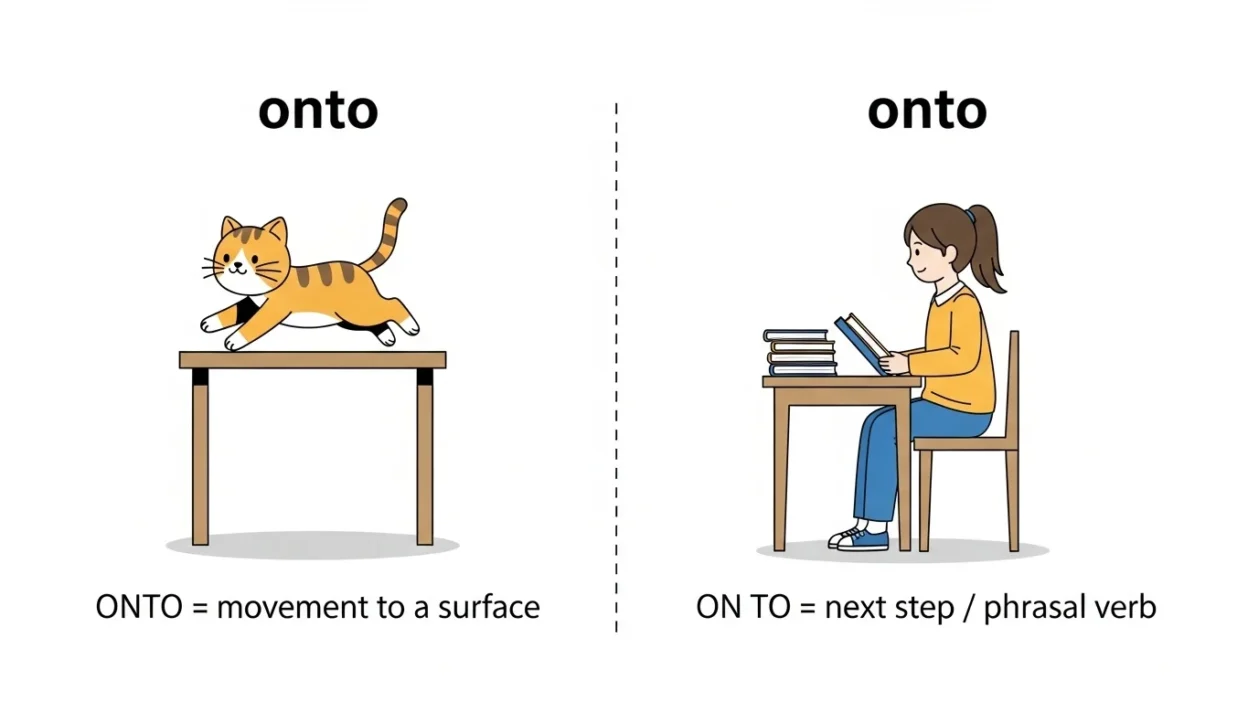
- Onto → shows movement toward a surface or awareness
- On to → two separate words used when “on” is part of a verb and “to” introduces the next action or topic
Examples:
Onto (movement to a surface)
- The cat jumped onto the table.
- She climbed onto the stage.
On to (continuing or phrasal verb)
- Let’s move on to the next topic.
- He held on to the rope carefully.
Origin and Background of On To vs Onto
- On → shows position or place. Example: The book is on the table.
- To → shows direction or purpose. Example: She went to school.
- Onto → one word, a preposition for movement to a surface or awareness.
- On to → two words, usually occurs when “on” belongs to a verb or phrasal verb.
Understanding this background helps explain why both forms exist.
Difference Between On To and Onto
1. Onto = Movement to a Surface
Use onto when something moves from one place to a surface:
- The dog jumped onto the sofa.
- She stepped carefully onto the platform.
- The child climbed onto the bed.
2. Onto = Awareness
“Onto” can also mean aware of something:
- The teacher is onto the cheating.
- She was onto the trick immediately.
3. On To = Two Words, Part of a Verb
Use on to when:
- “On” is part of a phrasal verb (hold on, catch on, log on)
- “To” introduces the next action or topic
Examples:
- We moved on to the next question.
- He held on to the rope tightly.
- Please log on to your account to continue.
Comparison Table: On To vs Onto
| Feature | On To | Onto |
| Word form | Two words | One word |
| Meaning | Continue to next step or phrasal verb | Movement to a surface or awareness |
| Common use | Lessons, discussions, phrasal verbs | Physical actions, awareness |
| Example | Move on to the next chapter | Jump onto the table |
| Focus | Progress or connection | Direction toward surface or awareness |
When to Use On To vs Onto
Use Onto When:
- Something physically moves to a surface
- You are aware of a fact or situation
Examples:
- The cat jumped onto the bed.
- The teacher is onto the student’s plan.
Use On To When:
- “On” is part of a phrasal verb
- You continue to the next step or topic
Examples:
- Let’s move on to the next topic.
- He held on to the rope.
- After finishing, we moved on to the next exercise.
Common Mistakes
- ❌ Using onto for topics: Let’s move onto the next topic.
✔ Correct: Let’s move on to the next topic. - ❌ Using on to for movement: The cat jumped on to the table.
✔ Correct: The cat jumped onto the table. - ❌ Confusing onto vs into: She jumped onto the pool.
✔ Correct: She jumped into the pool.
Everyday Real Life Examples
Emails
- Thank you for your feedback. Let’s move on to the next step.
Social Media
- I finished the first book and now I’m on to the second one!
School/Class
- Now we will move on to chapter three.
Daily Life / Physical Movement
- The child climbed onto the slide.
- The cat jumped onto the window.
Phrasal Verb Use
- Please hold on to the railing.
- Log on to your account to continue the course.
Learning Tips for Students and Learners
Tip 1: Think About Surfaces → Onto
- Movement to a surface → use onto
- Example: The book fell onto the floor.
Tip 2: Think About Progress → On To
- Continuing to the next step → use on to
- Example: Let’s move on to the next question.
Tip 3: Use a Memory Trick
- If “on top of” works → ONTO
- If “continue to” works → ON TO
Tip 4: Watch for Phrasal Verbs
- Hold on to, catch on to, log on to → use on to
Practice Exercise: Choose the Correct Option
- The dog jumped (on to / onto) the sofa.
- Let’s move (on to / onto) the next slide.
- He held (on to / onto) the rope tightly.
- The teacher is (onto / on to) the student’s trick.
- Please log (on to / onto) your account.
FAQ Section
1. Are “on to” and “onto” the same?
No. Onto shows movement or awareness, on to continues an action or belongs to a phrasal verb.
2. Can “onto” mean aware?
Yes. Example: The detective is onto the criminal’s plan.
3. When should I use “on to”?
When continuing an action or when “on” is part of a phrasal verb.
4. Are there interchangeable cases?
Yes. Sometimes both are correct depending on context: log on to / log onto your account.
5. Is “onto” one word?
Yes, always.
6. Can “on to” appear in phrasal verbs?
Yes. Examples: hold on to, catch on to, move on to
7. How can I remember the difference?
Onto = movement or awareness; On to = next step or phrasal verb.
Conclusion
The difference between on to vs onto is now clear:
- Onto → movement to a surface or awareness
- On to → continuing to the next step, or part of a phrasal verb
With practice and memory tricks, you can confidently use onto and on to in daily English, schoolwork, emails, and social media.