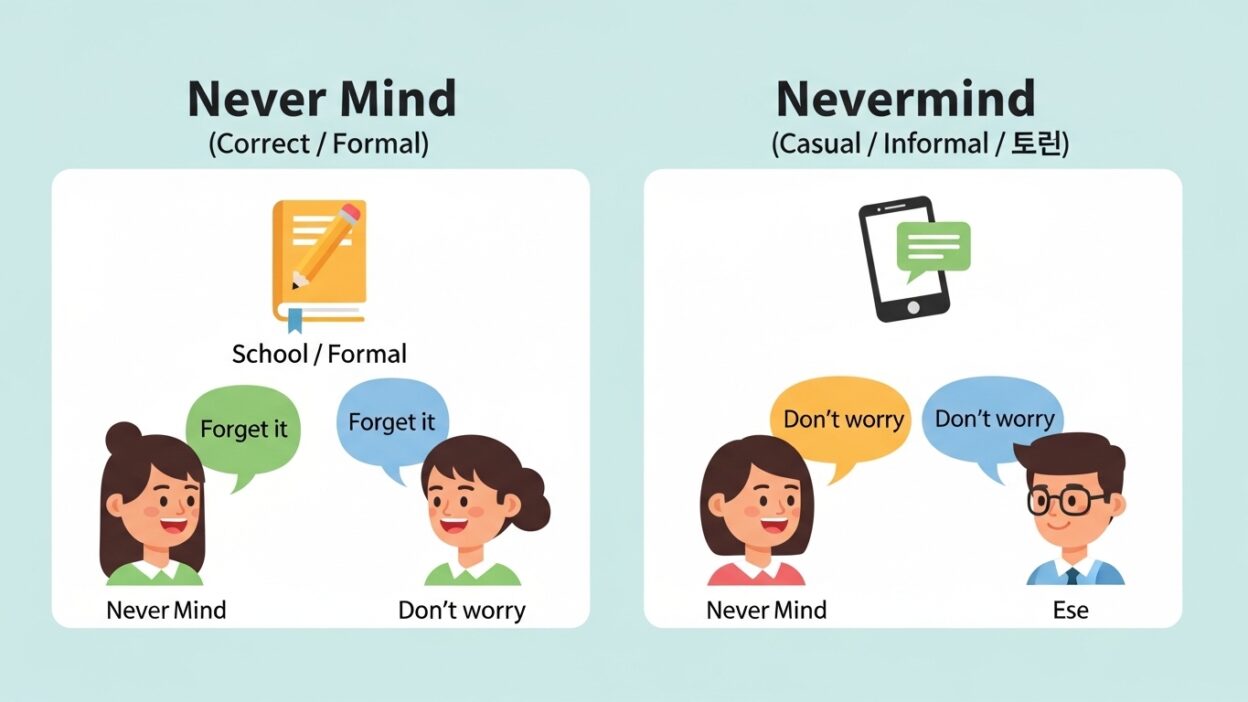
Many students and English learners often get confused about never mind vs nevermind. Both look and sound very similar, but they are used differently.
This article will explain the difference between never mind and nevermind, show you how to use them correctly, and give real-life examples so anyone can understand it on the first read.
Why People Get Confused
- Sound: “Never mind” and “nevermind” sound exactly the same when spoken.
- Spelling: Some people write them as one word, especially in casual texting or social media.
- Meaning: Both mean “forget it” or “don’t worry,” which adds to the confusion.
By understanding the difference, you can always choose the correct form in writing and speaking.
Quick Answer: Never Mind or Nevermind?
- Never mind ✅ – The correct and standard spelling. Use it in schoolwork, emails, or formal conversations.
- Nevermind ⚠️ – Informal, mostly for texting or social media. Some dictionaries accept it, but it’s not ideal in formal writing.
Tip: When in doubt, always use never mind.
Origin / Background
- Never mind meaning has existed in English for hundreds of years. It originally meant: “Don’t let it bother your mind” or “Forget about it.”
- Nevermind as one word is modern and mostly seen in casual writing, like text messages, social media posts, and song titles.
- Knowing this origin helps learners understand why never mind (two words) is always safer in formal writing.
Never Mind vs Nevermind: Clear Explanation
| Phrase/Word | Meaning | Use | Formality | Examples |
| Never mind | Forget it / don’t worry | Emails, essays, schoolwork, conversations | Formal ✅ | “I forgot your book. Never mind, I’ll bring it tomorrow.” |
| Nevermind | Same meaning but casual | Texts, social media, informal notes | Informal ⚠️ | “Nevermind, I figured it out! 😅” |
Mini-Tip: Think: two words = safe, one word = casual.
Which One to Use and When
- Use “never mind” when:
- Writing school essays, emails, or reports
- Talking to teachers, bosses, or formal contacts
- You want to be correct in English
- Use “nevermind” when:
- Chatting with friends
- Posting on social media
- Writing casually in texts
Quick Visual Cheat:
| Use Case | Correct Form |
| School / Homework / Essays | Never mind ✅ |
| Emails to teacher / boss | Never mind ✅ |
| Texting friends | Nevermind ⚠️ |
| Social media posts | Nevermind ⚠️ |
| Spoken English (all situations) | Never mind ✅ |
Common Mistakes People Make
- Writing nevermind in essays or emails (wrong in formal writing).
- Confusing never mind with “mind your own business” – they are not the same.
- Thinking never mind is rude – it is polite when used correctly.
- Forgetting to separate “never” and “mind” in formal writing.
Everyday Real Life Examples
Conversations
- Friend: “I forgot your homework.”
- You: “Never mind, I can help you tomorrow.”
Emails
- “Thanks for your help. If you can’t finish it today, never mind.”
Social Media / Texts
- “Nevermind, I solved the problem myself! 😅”
- “Oh, you sent the wrong file? Nevermind, I already fixed it.”
School or Classroom
- Teacher: “We’ll skip today’s quiz.”
- Student: “Never mind, I was ready anyway.”
British vs American English
- British English: “Never mind” is slightly more common in formal speech and writing.
- American English: “Never mind” is standard; “nevermind” appears mostly in casual digital communication.
Learning Section for Students and Beginners
Steps to remember:
- Two words = never mind meaning ✅ correct
- One word = nevermind meaning ⚠️ casual
- Meaning = forget it / don’t worry
- Use it in friendly speech or writing depending on context
Practice Sentences:
- “I lost the keys.” → “Never mind, we can find them later.”
- “I forgot your birthday.” → “Never mind, we’ll celebrate next week.”
- Text: “I can’t come to the party.” → “Nevermind, we’ll meet another time! 😄”
FAQ: Never Mind vs Nevermind
Q: Can I use “nevermind” in an essay?
A: No. Use never mind for correct English.
Q: Are “never mind” and “nevermind” the same?
A: They mean the same, but never mind is formal and correct.
Q: Is “never mind” rude?
A: No, it is polite. It tells someone not to worry.
Q: Can I say “never mind” to a teacher?
A: Yes, it is polite and safe.
Q: When is “nevermind” okay?
A: In texting friends or casual social media posts.
Q: Is “never mind” only spoken, or can I write it?
A: You can write it in emails, essays, texts, or notes.
Q: Can I replace “never mind” with “forget it”?
A: Yes, “forget it” is a simple synonym for beginners.
Q: Why do people write “nevermind”?
A: It’s easier in fast texting and informal writing.
Conclusion
Now you can confidently use never mind vs nevermind.
- Never mind → always correct and formal ✅
- Nevermind → casual, informal ⚠️
- Use never mind for school, work, and polite conversation.
- Use nevermind for texts, social media, or friendly chats.
Remember: Two words = safe, one word = casual.
With this guide, you’ll never get confused about never mind meaning, nevermind meaning, or how to use never mind vs nevermind again.