English learners often get confused between “me either” and “me neither.” Both phrases are used to agree with negative sentences, but only one is correct in standard English.
If you say the wrong one, your English can sound strange, especially in writing, exams, or formal communication.
This guide explains everything in simple English, with easy examples, exercises, and everyday English expressions for beginners and learners.
By the end, you will confidently know when to say “me neither” and avoid the common mistake of saying “me either.”
Quick Answer: Me Either vs Me Neither ✅
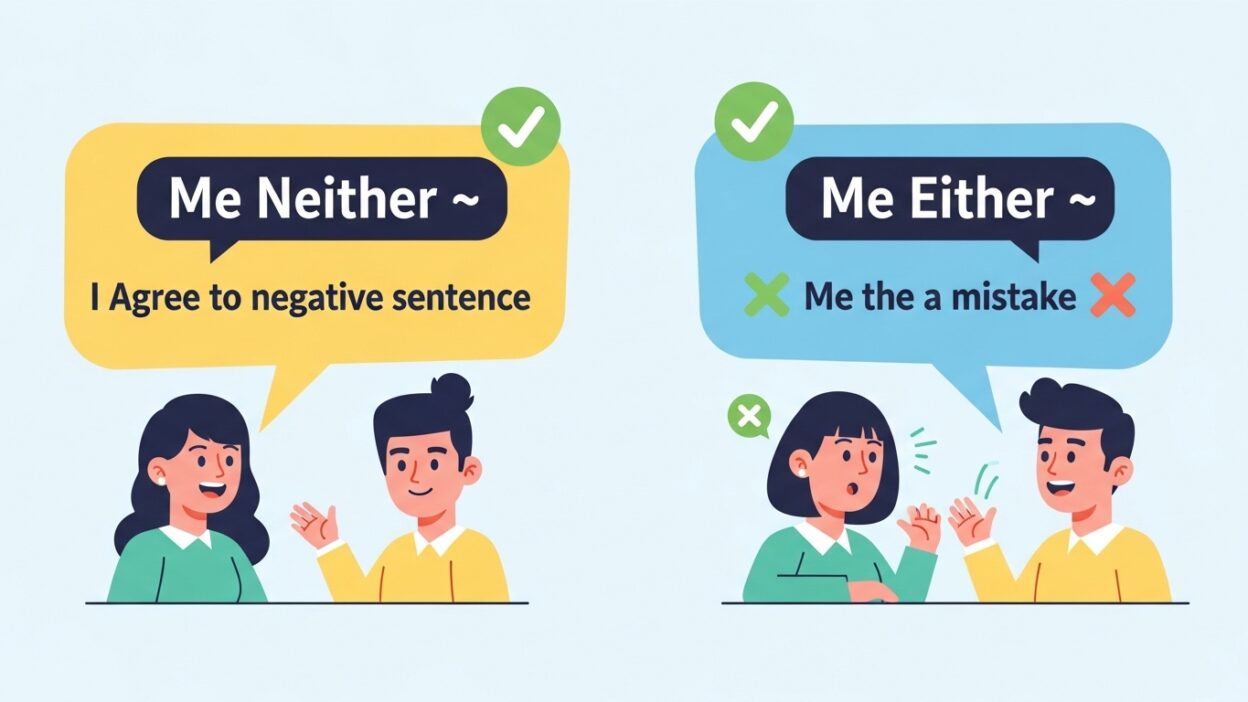
- Me neither → Correct for agreeing with negative sentences. Always standard.
- Me either → Informal, non-standard. Avoid in writing and formal English.
Examples:
- A: I don’t like broccoli. → B: Me neither. ✅
- A: I can’t swim. → B: Me neither. ✅
- A: I don’t like homework. → B: Me either. ❌ (incorrect in standard English)
Tip: If in doubt, always use me neither.
Quick Pronunciation Note
- Me neither: /mi ˈniːðər/
- Me either: /mi ˈaɪðər/ (sometimes pronounced like “me eether”)
Most ESL learners find “me neither” easier to pronounce correctly.
Simple Background: Where the Confusion Comes From
The confusion comes from “either” and “neither.”
- Neither = “not one and not the other.”
- Either = “one or the other.”
Historically, people sometimes said “me either” instead of “me neither” in casual speech. Over time, “me neither” became the standard phrase to agree with negatives.
Clear Explanation of the Difference
Me Neither : Standard English
Use me neither to agree with a negative sentence.
Examples:
- I don’t like cold weather. → Me neither.
- I can’t drive yet. → Me neither.
- I haven’t finished my homework. → Me neither.
Me Either : Informal, Non-standard
Some people say me either in casual conversation, but it is not correct in standard English grammar.
- Example (spoken): I don’t like spinach. → Me either. ❌ (okay informally but avoid in writing)
Rule: For exams, emails, and formal writing, always use me neither.
Comparison Table: Me Either vs Me Neither
| Feature | Me Neither ✅ | Me Either ❌ |
| Usage | Agree with negative sentences | Informal, casual speech |
| Standard English | Yes | No |
| Correct in writing | Yes | No |
| Example | I don’t like cats. → Me neither. | I don’t like cats. → Me either. |
| Safe for beginners | Yes | No |
| Everyday English use | All situations | Only casual conversations |
Which One to Use and When
Use “me neither”:
- In negative sentences
- In emails, essays, exams, and formal writing
- In everyday English to sound natural
Avoid “me either”:
- It’s non-standard and can confuse teachers or readers
- Only appears in casual spoken English or some movies/TV shows
Quick Rule for Beginners:
- Positive sentence → Me too
- Negative sentence → Me neither
Common Mistakes People Make
- Using “me either” in writing or exams
❌ Wrong: I don’t like math. → Me either.
✅ Correct: I don’t like math. → Me neither. - Using “me neither” after a positive sentence
❌ Wrong: I love chocolate. → Me neither.
✅ Correct: I love chocolate. → Me too. - Confusing “me too” with “me neither”
- Positive agreement → Me too
- Negative agreement → Me neither
- Positive agreement → Me too
Everyday Real Life Examples
Conversations
- A: I don’t like rainy days.
- B: Me neither.
Emails
- I haven’t finished the project yet. → Me neither!
Social Media
- Post: I can’t believe Monday is here again.
- Comment: Me neither! 😅
Daily Use
- Friend: I don’t want to go shopping.
- You: Me neither.
Interactive Mini Exercises for Students
Choose the correct answer:
- I don’t like tea. → ___
a) Me too
b) Me neither ✅ - I can’t swim. → ___
a) Me either ❌
b) Me neither ✅ - I love pizza. → ___
a) Me too ✅
b) Me neither ❌
Answer key at the bottom:
1-b ✅, 2-b ✅, 3-a ✅
Tip: Practicing like this helps internalize the rule.
Short Learning Section for Beginners
- Listen to a negative sentence.
- Respond with “Me neither.”
- Avoid “me either” in writing.
- Remember: Positive → Me too | Negative → Me neither
Practice Example:
- Teacher: I don’t like spicy food. → Student: Me neither! ✅
- Friend: I can’t drive yet. → You: Me neither! ✅
FAQ Section: Me Either vs Me Neither
1. Can I say “me either” in conversation?
Yes, but it’s informal. Me neither is always safer.
2. Is “me neither” correct in writing?
Yes, it is standard English and correct for emails, exams, and assignments.
3. Can I use “me neither” after a positive sentence?
No. Use me too for positive sentences.
4. What is the difference between “me too” and “me neither”?
- Me too → Agree with positives
- Me neither → Agree with negatives
5. Why do people say “me either”?
It comes from casual or older spoken English but is not standard today.
6. Can beginners use “me neither” safely?
Yes, it’s the easiest and safest phrase for ESL learners.
7. Any social media examples?
- Tweet: I can’t wake up early. → Comment: Me neither! 😴
8. Does “me either” appear in formal English?
No. Avoid it in writing, exams, and professional communication.
Conclusion: Easy Rule to Remember
“Me neither” is the correct phrase to agree with negative sentences. It is safe, simple, and standard English.
“Me either” may appear in casual speech, but it is not recommended for writing or exams.
Rule for beginners:
- Positive sentence → Me too
- Negative sentence → Me neither
Practice with these everyday English expressions, interactive exercises, and real life examples. Soon, you will never confuse “me either vs me neither” again!