Many students and learners feel confused about loose vs lose. These two words look almost the same. They sound similar. They are only different by one letter.
Because of this, they are one of the most common spelling mistakes in English writing. Even native speakers sometimes mix them up when typing fast.
If you have searched for the difference between loose and lose, this guide will help you understand it clearly and remember it forever.
Quick Answer: Loose vs Lose Explained Simply
Here is the simple rule:
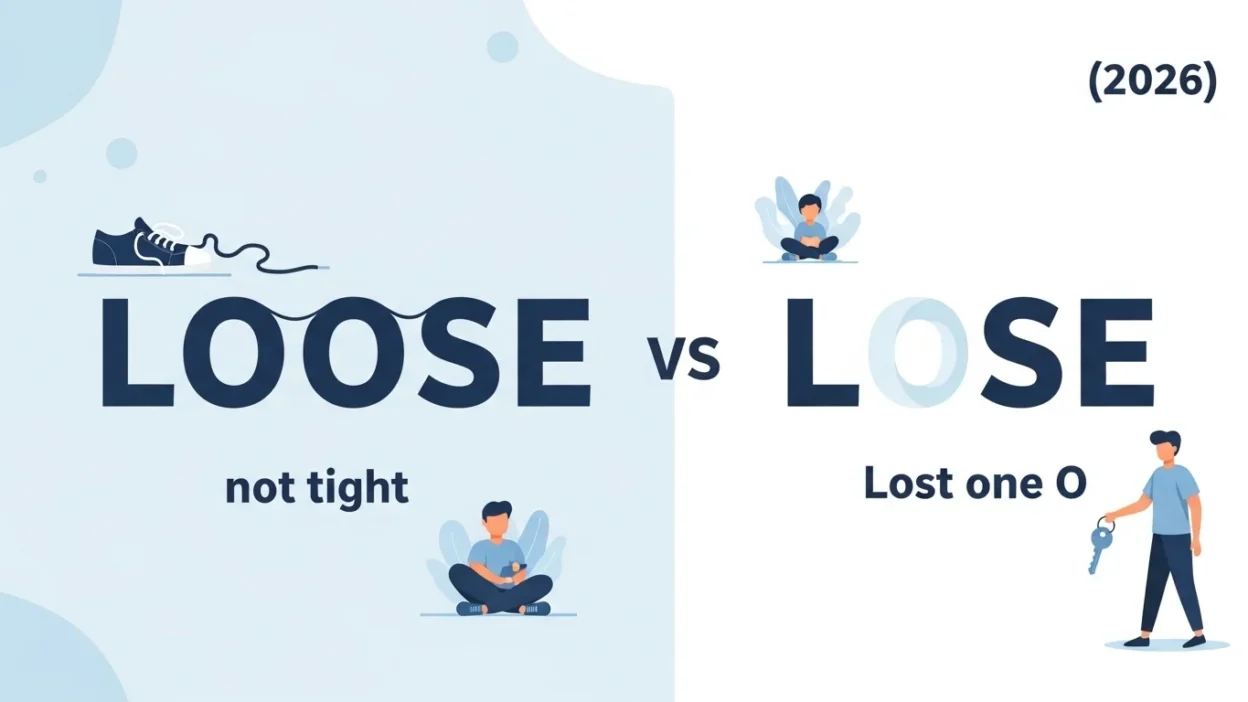
- Loose = not tight
- Lose = to not have something anymore
Super Simple Memory Trick
- Loose has two O’s → something wide, open, not tight
- Lose has one O → you “lost” one O
If you remember this, you will avoid most common mistakes loose and lose.
Loose and Lose Meaning in English
Loose Meaning in English
The loose meaning in English is:
- Not tight
- Not fixed
- Not secure
- Free to move
Examples:
- My shirt is too loose.
- The screw is loose.
- The dog is running loose.
- I prefer loose clothing.
In every example, something is not tight or not strongly attached.
Lose Meaning in English
The lose meaning in English is:
- To not have something anymore
- To not win
- To misplace something
- To fail to keep something
Examples:
- I don’t want to lose my phone.
- Our team might lose the game.
- Don’t lose your keys.
- She may lose her job.
In every example, something is being lost or not kept.
Clear Difference Between Loose and Lose
Understanding loose vs lose grammar becomes easy when you remember this:
- Loose is usually an adjective (a describing word).
- Lose is a verb (an action word).
If you are describing something → use loose.
If you are showing an action → use lose.
Loose vs Lose Pronunciation (Very Important for Learners)
Many learners struggle with loose vs lose pronunciation.
Here is the simple difference:
- Loose → ends with an S sound (like “ssss”)
- Lose → ends with a Z sound (like “zzzz”)
How to Practice the Sound
Say these slowly:
- Loose → looss
- Lose → looz
Put your hand on your throat:
- When you say loose, your throat does NOT vibrate much.
- When you say lose, your throat vibrates because of the Z sound.
Practice pairs:
- loose / lose
- bus / buzz
- ice / eyes
This helps your speaking improve.
Common Real Life Phrases (Very Useful)
Understanding common phrases helps you master loose vs lose in sentences.
Common Phrases with “Lose”
- Lose weight
- Lose control
- Lose interest
- Lose money
- Lose your temper
- Lose a game
Examples:
- I want to lose weight.
- He might lose control.
- Don’t lose interest in your studies.
Common Phrases with “Loose”
- Loose change
- Loose connection
- Loose clothing
- Loose screw
- Loose hair
Examples:
- I have some loose change in my pocket.
- There is a loose connection in the wire.
- She likes loose clothing.
These phrases are very common in daily English.
Loose vs Lose Comparison Table
| Feature | Loose | Lose |
| Type of word | Adjective | Verb |
| Meaning | Not tight | Not have anymore |
| Example | My shoes are loose. | I might lose my shoes. |
| Sound | Ends with S sound | Ends with Z sound |
| O letters | Two O’s | One O |
This table makes the lose vs loose correct usage clear.
Why Even Native Speakers Confuse Loose and Lose
Many people mix them up because:
- They look almost the same.
- They sound similar in fast speech.
- Typing errors happen easily.
- Auto-correct does not always fix it.
- English spelling is not always logical.
This is why common mistakes loose and lose happen so often.
When to Use Loose and Lose
Use “Loose” When:
You are describing something that:
- Is not tight
- Is not secure
- Is free to move
If you can replace it with “not tight,” use loose.
Use “Lose” When:
You are talking about:
- Not winning
- Not having something anymore
- Something going away
If you can replace it with “not win” or “not keep,” use lose.
Word Family of “Lose” (Helpful for Students)
Understanding word family helps avoid mistakes.
- Lose (present)
- Lost (past)
- Losing (continuous form)
- Loser (person who loses)
Examples:
- I lost my wallet.
- She is losing confidence.
- Nobody likes to be called a loser.
Notice: “Loose” does NOT follow this pattern.
Everyday Examples (Emails, School, Social Media)
In Emails
- “Please don’t lose this file.”
- “The button is loose, please fix it.”
In School
- “If you don’t study, you may lose marks.”
- “Your shoelaces are loose.”
On Social Media
- “I always lose my charger!”
- “These jeans are too loose.”
In News
- “The team may lose the final.”
- “A loose cable caused the problem.”
Practice Quiz: Test Yourself
Choose the correct word (loose or lose):
- Don’t ______ your phone.
- My tooth is ______.
- We might ______ the match.
- This screw is ______.
- I don’t want to ______ money.
- His shirt is too ______.
Answers
- lose
- loose
- lose
- loose
- lose
- loose
If you got most correct, you understand loose vs lose for students very well.
Common Mistakes and How to Avoid Them
❌ I don’t want to loose my keys.
✅ I don’t want to lose my keys.
❌ My shoes are lose.
✅ My shoes are loose.
Quick Fix Rule
If it is an action → lose
If it describes something → loose
Final Quick Summary Box
Before you finish, remember this:
- Loose = not tight (adjective, two O’s, S sound)
- Lose = not have anymore (verb, one O, Z sound)
Loose describes.
Lose shows action.
Two O’s = wide and open.
One O = lost something.
Conclusion
The difference between loose and lose is simple once you understand the rule.
Loose means not tight.
Lose means to not have something anymore.
You now know:
- The meaning
- The pronunciation
- The grammar difference
- Common phrases
- Real-life examples
- Practice questions
With regular practice, you will never confuse loose vs lose again. English becomes easier when you break it into small, clear rules like this. Keep practicing, and your confidence will grow every day.