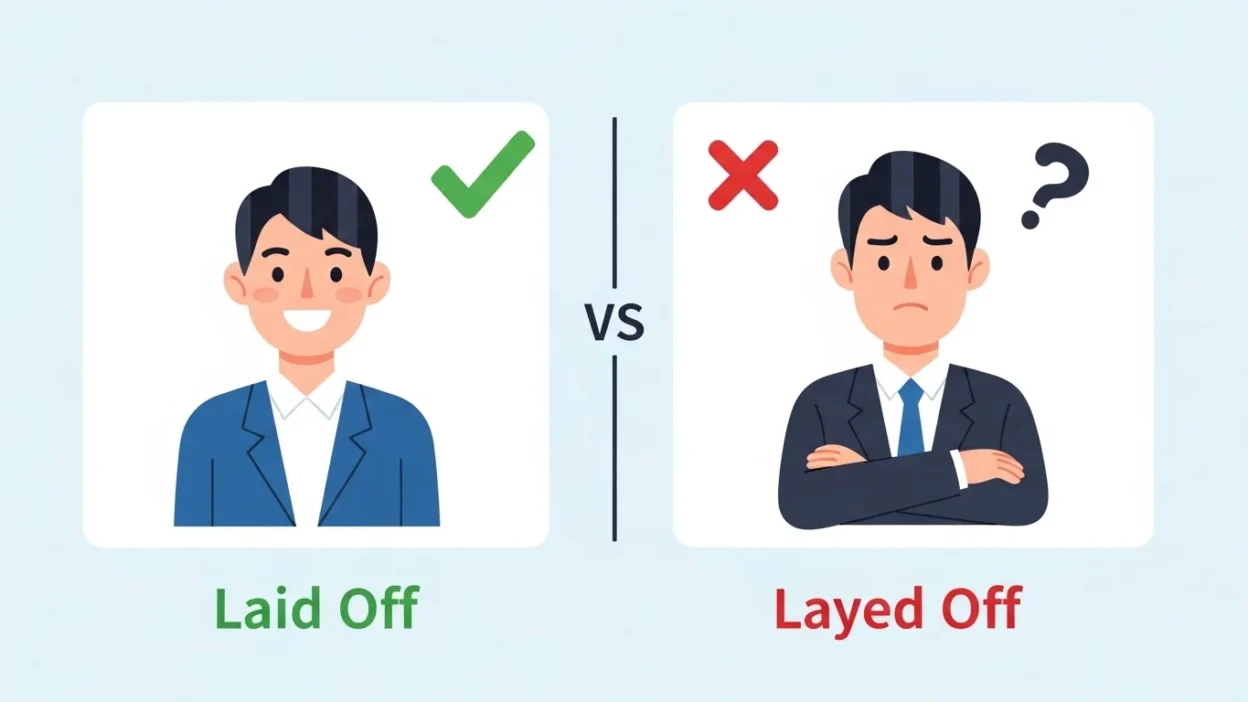
Many people get confused about “laid off vs layed off”. Even native English speakers sometimes make mistakes.
If you are learning English, this guide will explain the difference between laid off and layed off in very simple words. After reading this, you will always know which one is correct.
Why People Get Confused
- The words sound very similar when spoken.
- English spelling rules can be tricky.
- Some people try to guess the past tense of “lay off” and write layed off.
- Beginners often don’t know the correct spelling of laid off or layed off.
Quick Answer: Laid Off Meaning
Here’s the simple rule:
- ✅ Correct: Laid off → past tense of lay off
- ❌ Incorrect: Layed off → never use this
- 💡 Tip: Always use laid off when talking about losing a job because of company reasons.
Simple Background of “Lay Off”
- The verb “lay off” started long ago in English, meaning to stop doing or using something.
- Today, it is also used for job loss due to company reasons.
- The past tense of lay off is always laid off.
- Remember: layed off is wrong.
Difference Between Laid Off and Layed Off
| Word | Correct? | Meaning | Example Sentence |
| Laid off | ✅ Yes | Past tense of “lay off” (job loss) | “She was laid off last month due to budget cuts.” |
| Layed off | ❌ No | Not a word | ❌ “He was layed off yesterday.” |
Extra tip: “Laid off” is not your fault. “Fired” usually means you did something wrong.
When to Use “Laid Off”
Use laid off in these situations:
- When a company reduces staff because of money problems
- When your job is not needed anymore
- For full-time, part-time, or temporary jobs
Examples:
- “Many workers were laid off last year because the factory closed.”
- “I was laid off from my part-time job.”
- “It’s important to know the correct spelling: laid off or layed off.”
Common Mistakes to Avoid
| Mistake | Correct Version | Explanation |
| Layed off | Laid off | “Layed” is never correct |
| I lay off last month | I was laid off last month | Past tense needs “was” |
| Using laid off for bad behavior | Fired | Laid off is for company reasons, not mistakes |
Everyday Real Life Examples
Emails:
- “Dear team, due to budget cuts, several staff members were laid off.”
News Headlines:
- “Tech company laid off 200 employees this week.”
Social Media:
- “Feeling sad today. I just got laid off from my job.”
Daily Conversations:
- “My friend was laid off last year, but she found a new job soon after.”
Learners Example:
- “Many learners ask about the difference between laid off and layed off.”
Mini Practice Section for Students
Choose the correct answer:
- He was ___ (laid off / layed off) last week. ✅
- Many workers were ___ (laid off / layed off) due to budget cuts. ✅
- I was ___ (laid off / layed off) because the company closed. ✅
- ❌ Wrong: “She was ___ (laid off / layed off) yesterday.”
Tip: Always pick laid off.
Short Learning Tips for Beginners
- Tip 1: “Laid” = past tense of “lay.”
- Tip 2: Laid off = job loss by company, not your fault.
- Tip 3: Never write layed off.
- Tip 4: Say out loud: “laid off” → correct, “layed off” → wrong.
- Tip 5: Remember common English mistakes: laid off.
FAQ Section
1. Can I say “layed off”?
- ❌ No, the correct word is laid off.
2. What does “laid off” mean?
- It means someone lost their job because the company didn’t need them.
3. Is “laid off” the same as “fired”?
- No. Fired = your fault. Laid off = company’s choice.
4. Can I use “laid off” for part-time jobs?
- ✅ Yes, it works for full-time, part-time, and temporary jobs.
5. How do I remember it?
- Think: past tense of lay off is laid off, never layed off.
6. Can I say “He was laid off yesterday”?
- ✅ Yes, that is correct.
7. Is “lay off” used in other ways?
- Yes, it can mean “stop doing something” or “stop bothering someone.”
- Example: “Lay off the sugar.”
- Example: “Lay off the sugar.”
8. Why do learners confuse it?
- Because it sounds similar to “layed off” and English past tense rules can be tricky.
Conclusion
Always use “laid off” when talking about someone losing a job for company reasons. Layed off is never correct.
By practicing these examples, mini exercises, and daily sentences, you will never confuse laid off and layed off.
✅ Quick Tip: When in doubt, write laid off – it’s always safe.