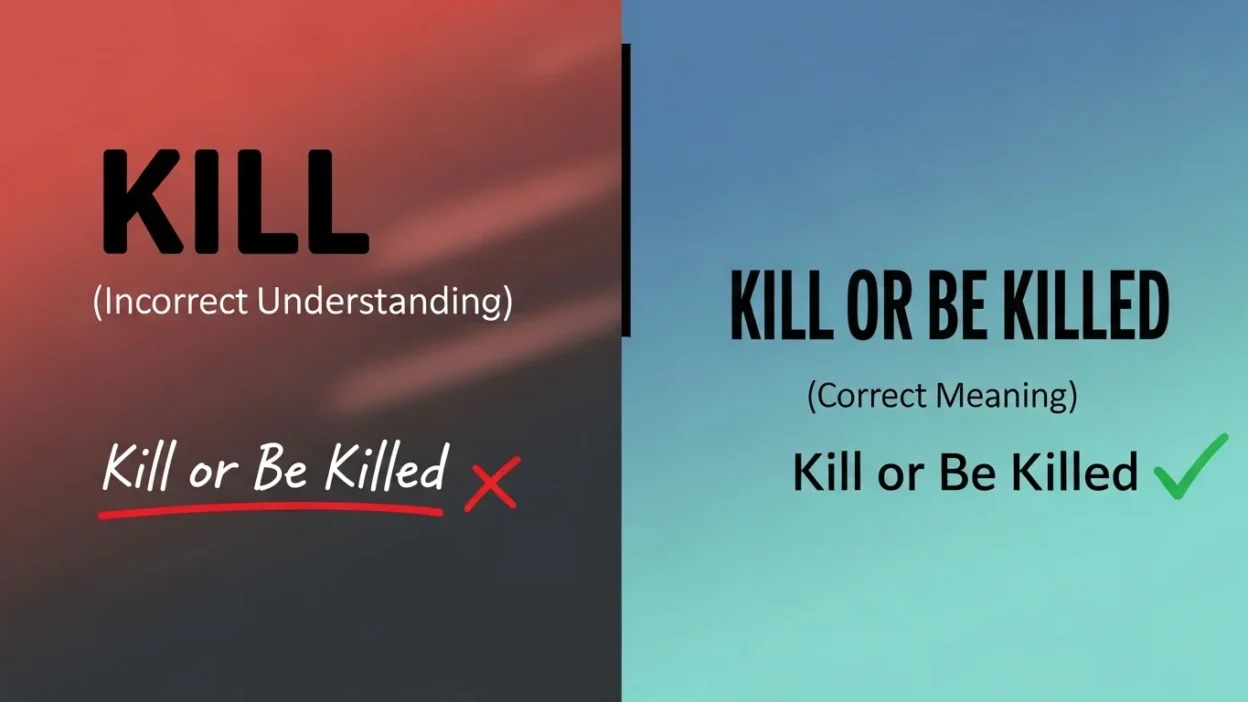
Many students and English learners feel confused when they hear the phrase “kill or be killed.”
The words look simple. But the meaning feels strong, serious, and sometimes scary.
Some people think it is only about war. Others think it is just a movie phrase. Some are not sure if it is real or only dramatic language.
In this article, we will explain everything in very simple English. After reading this, you will clearly understand what it means, how it is used, and when to use it.
Quick Answer: What Does “Kill or Be Killed” Mean?
“Kill or be killed” means:
- You must defeat or destroy someone before they destroy you.
- It is about survival in a very dangerous situation.
- It describes a fight where only one side can survive.
- It can be real (war, animals in the wild).
- It can also be used in a dramatic or emotional way (business, sports, competition).
In short:
👉 If you do not act first, you will lose or be destroyed.
Simple Origin and Background
The idea behind “kill or be killed” is very old.
It comes from:
- Ancient wars
- Battles between groups
- Survival situations in nature
- Dangerous animal attacks
In the past, if two enemies fought with weapons, only one could live. So the rule was simple:
You kill your enemy first, or your enemy kills you.
Over time, this phrase became common in:
- War stories
- Action movies
- Military speech
- Survival discussions
Today, people also use it in a figurative (not real killing) way.
Clear Explanation of the Meaning
Let’s break the phrase into two parts:
1. “Kill”
This means:
- To cause someone’s death.
- To destroy completely.
2. “Be killed”
This means:
- To die because someone else killed you.
- To be destroyed by someone else.
Together: “Kill or be killed”
It describes a situation where:
- There are only two sides.
- Both sides cannot survive.
- You must attack or defend strongly.
- There is no peaceful option.
It is about extreme survival.
Is It Always About Real Killing?
No.
There are two main ways this phrase is used:
1. Literal Meaning (Real Danger)
This is about real life or death situations:
- War
- Military combat
- Animal survival in the wild
- Self defense situations
Example:
In battle, soldiers sometimes face a kill or be killed situation.
Here, it means real danger.
2. Figurative Meaning (Not Real Death)
People also use it in a dramatic way.
For example:
- Business competition
- Sports games
- Politics
- Exams and career pressure
Example:
The business world can feel like kill or be killed.
Here, nobody is actually dying. It means:
- Very strong competition
- No mercy
- You must act quickly or lose
Easy Comparison Table
| Point | Literal Meaning | Figurative Meaning |
| Is it about real death? | Yes | No |
| Where is it used? | War, survival | Business, sports, competition |
| Is it serious? | Extremely serious | Dramatic expression |
| Is it common in daily talk? | Not very common | More common |
| Tone | Life threatening | Strong and emotional |
This table helps you see the difference clearly.
Which One Should You Use and When?
Use It in Serious Situations When:
- Talking about war
- Writing a story about survival
- Describing dangerous combat
- Explaining extreme self defense
Example:
The soldier knew it was kill or be killed.
Use It in a Figurative Way When:
- Talking about intense competition
- Describing a stressful work environment
- Discussing tough sports matches
Example:
In the final match, it was kill or be killed.
When NOT to Use It
Do not use this phrase:
- In polite conversation
- In formal academic writing
- When the situation is small or unimportant
- In sensitive situations involving real violence
It is a strong expression. Use it carefully.
Common Mistakes People Make
❌ Mistake 1: Using It for Small Problems
Wrong:
I had to finish my homework. It was kill or be killed.
Homework is not life threatening. This sounds too dramatic.
❌ Mistake 2: Using It in Formal Writing
In academic essays, it sounds too emotional.
Better to use:
- “Very competitive”
- “Highly challenging”
- “Extremely intense”
❌ Mistake 3: Thinking It Always Means Real Killing
Many learners believe it always means real death.
Remember:
It can be literal or figurative.
❌ Mistake 4: Using It in Sensitive Topics
If someone is talking about real violence or trauma, avoid using this phrase casually.
It may sound insensitive.
Everyday Real Life Examples
Here are simple examples to help you understand better.
1. In an Email
The market is very competitive. It feels like kill or be killed.
This means the competition is very strong.
2. In News
The soldiers faced a kill or be killed situation during the battle.
This means real danger.
3. On Social Media
Startup life is kill or be killed!
This means strong competition.
4. In Sports
In the final round, it was kill or be killed.
This means:
One team had to win. There was no second chance.
5. In Daily Conversation
In that company, it’s kill or be killed.
This means:
- No one helps you.
- Everyone competes strongly.
Learning Section for Students and Beginners
If you are an ESL learner, follow these tips:
1. Remember the Core Idea
The main idea is:
Extreme survival or extreme competition.
2. Notice the Tone
This phrase is:
- Strong
- Emotional
- Dramatic
It is not soft or polite.
3. Practice Simple Sentences
Try making your own:
- The jungle is kill or be killed.
- The championship match was kill or be killed.
- The business world can feel kill or be killed.
4. Learn Similar Expressions
Here are similar phrases:
- Survival of the fittest
- Fight for survival
- No mercy
- Win or lose
These have related meanings but are not exactly the same.
Frequently Asked Questions (FAQ)
1. Is “kill or be killed” always about violence?
No. It can describe real violence, but it is often used in a dramatic way about competition.
2. Is this phrase rude?
Not exactly rude, but it is very strong. It may sound aggressive.
3. Can I use it in an exam essay?
It is better to avoid it in formal writing unless you are writing a story or discussing war.
4. Is it common in movies?
Yes. Action and war movies use it often because it sounds dramatic and powerful.
5. Is it correct grammar?
Yes. It is grammatically correct.
“Kill” is active.
“Be killed” is passive.
6. Can children use this phrase?
It depends on context. It is a strong phrase, so teachers usually avoid it in basic classroom speech.
7. Is there a softer version of this phrase?
Yes. You can say:
- Extremely competitive
- High pressure
- Intense situation
These sound less violent.
8. Does it mean you must attack first?
Not always. It means you must act strongly to survive. That action could be defense or attack.
Conclusion
The phrase “kill or be killed” describes an extreme situation where only one side can survive.
It can mean:
- Real life and death danger
- Very intense competition
The key idea is survival under serious pressure.
For students and English learners, remember:
- It is a strong expression.
- It should be used carefully.
- It is common in dramatic speech, movies, and competition talk.
- It is not suitable for polite or formal writing.
Now, when you hear “kill or be killed,” you will understand it clearly and confidently without confusion.