If you feel confused about invoke vs provoke, you are not alone. These two words look similar, but they are used in very different ways. Many students and learners mix them up, especially when writing or speaking.
The good news is simple: once you understand one key idea, the confusion disappears. This guide will help you clearly understand the difference between invoke and provoke in the easiest way possible.
Quick Answer
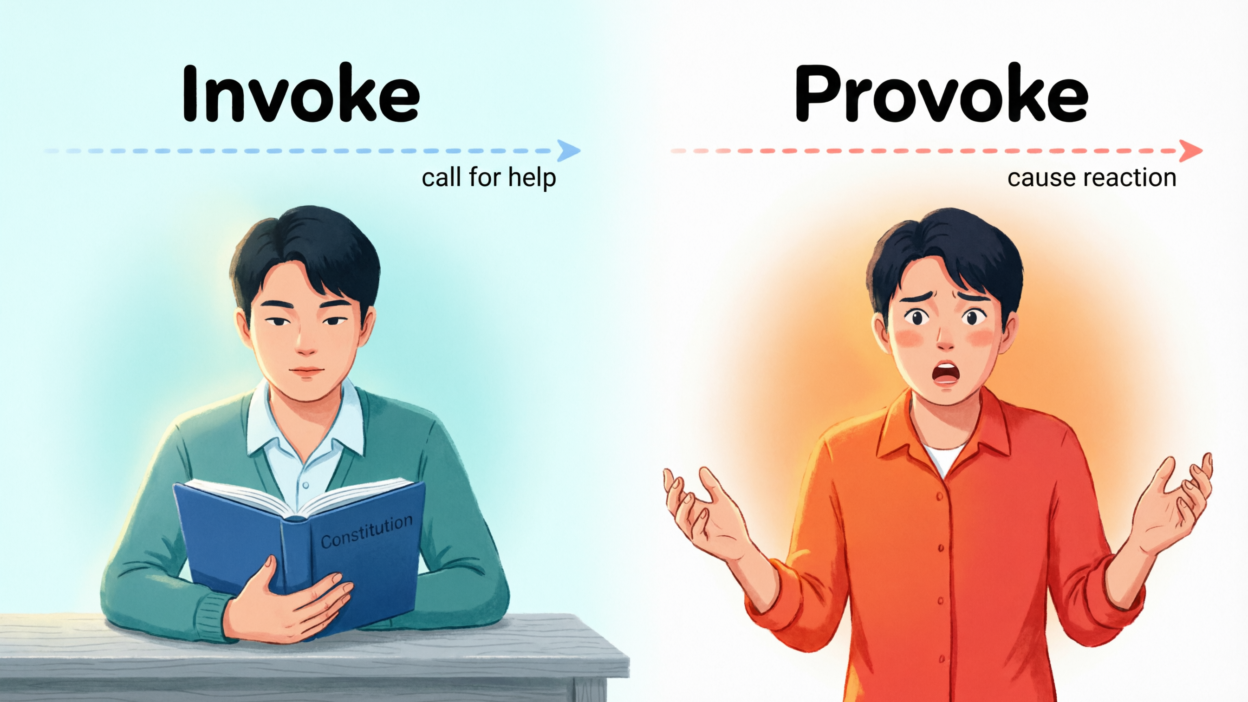
- Invoke = to call for help, support, or a rule
- Provoke = to cause a reaction (often anger or emotion)
👉 Easy way to remember:
- Invoke = ask or bring in
- Provoke = cause or push out
Simple Origin (Easy Idea)
- Invoke → think “call for help”
- Provoke → think “cause a reaction”
You don’t need to remember history—just remember the idea.
Clear Explanation of the Difference
What Does “Invoke” Mean?
Invoke means to call on something for support, help, or authority.
You use it when you:
- Refer to a rule, law, or right
- Ask for support
- Bring in an idea or memory
Examples:
- She invoked her right to speak.
- The lawyer invoked the law.
- His speech invoked hope in people.
👉 Tone: calm, controlled, often formal
What Does “Provoke” Mean?
Provoke means to cause a reaction, especially a strong or emotional one.
You use it when something:
- Makes someone angry
- Starts a reaction
- Triggers emotion
Examples:
- His comment provoked anger.
- The news provoked a strong reaction.
- Her actions provoked an argument.
👉 Tone: emotional, often negative
Comparison Table
| Feature | Invoke | Provoke |
| Meaning | Call for help or authority | Cause a reaction |
| Use with | Laws, rights, ideas | Emotions, reactions |
| Tone | Calm, formal | Emotional, often negative |
| Direction | Bringing something in | Causing something to happen |
| Example | Invoke a rule | Provoke anger |
Think of It This Way
- You invoke something when you need support
- You provoke something when you cause a response
👉 One simple line:
Invoke = asking
Provoke = causing
Which One to Use and When
Use “Invoke” when:
- Talking about rights, laws, or rules
- Asking for help or support
- Referring to something powerful or important
Common patterns:
- invoke a right
- invoke a law
- invoke a memory
Use “Provoke” when:
- Talking about emotions or reactions
- Someone causes anger or trouble
- Something creates a strong response
Common patterns:
- provoke anger
- provoke a reaction
- provoke a debate
Common Mistakes to Avoid
1. Using the wrong word for emotions
❌ His words invoked anger.
✔ His words provoked anger.
👉 Emotions = use provoke
2. Using the wrong word for rules
❌ She provoked her rights.
✔ She invoked her rights.
👉 Rules/rights = use invoke
3. Thinking both words are the same
They are different:
- Invoke = call for something
- Provoke = cause something
Real Life Examples
In Emails
- I would like to invoke company policy for this request.
- His message provoked confusion among the team.
In News
- The lawyer invoked the constitution.
- The decision provoked protests.
On Social Media
- That post provoked many angry comments.
- She invoked her experience to explain her opinion.
In Conversations
- Why did he provoke her?
- She didn’t invoke her rights during the meeting.
Sentence Patterns
Learning patterns makes your English stronger:
With “Invoke”
- invoke + rule/law/right
- invoke + support/idea/memory
✔ Example:
- He invoked his right to remain silent.
With “Provoke”
- provoke + emotion (anger, fear, laughter)
- provoke + reaction (response, debate)
✔ Example:
- The comment provoked laughter.
Short Learning Section for Students
Easy Memory Trick
- Invoke → Invite help
- Provoke → Produce reaction
Quick Practice
Fill in the blanks:
- The teacher ______ the school rules.
- His behavior ______ anger.
- She ______ her right to speak.
- The video ______ strong reactions.
Answers:
- invoked
- provoked
- invoked
- provoked
FAQ Section
1. What is the difference between invoke and provoke?
Invoke means to call for help or authority. Provoke means to cause a reaction.
2. Can “provoke” be positive?
Sometimes, yes. It can mean causing thought or discussion, but it is often negative.
3. Is “invoke” formal or informal?
It is usually formal and used in serious situations.
4. Can I use these words in essays?
Yes. Both words are useful in writing, especially in formal English.
5. Which word is used with emotions?
Use provoke with emotions like anger or fear.
6. Which word is used with laws or rights?
Use invoke with laws, rights, and rules.
7. Can both words be used in one sentence?
Yes.
Example: He invoked the rule, which provoked anger.
8. What is the easiest way to remember them?
Think:
- Invoke = ask
- Provoke = cause
Conclusion
The confusion between invoke vs provoke is very common, but the solution is simple:
- Invoke means calling for help, support, or authority
- Provoke means causing a reaction or emotion
👉 Final memory line:
Invoke is about asking. Provoke is about causing.
With clear examples and practice, you can now use both words correctly in daily English without confusion.