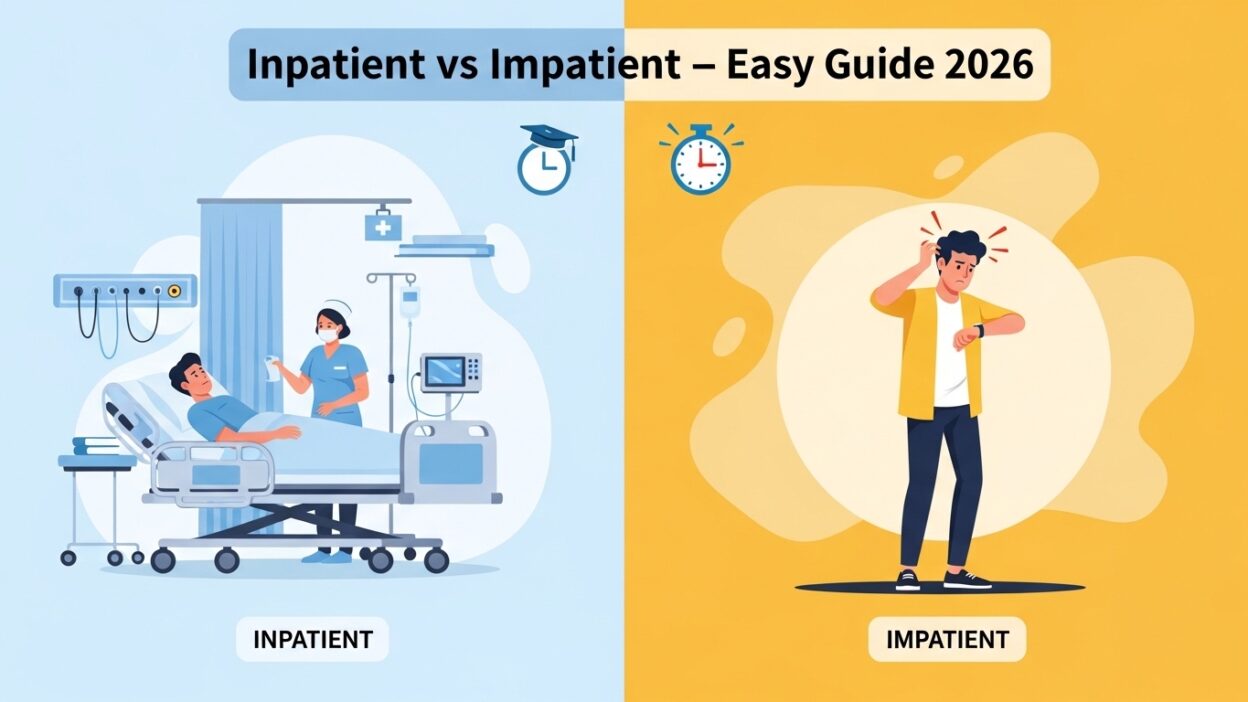
Many students and learners get confused between inpatient vs impatient. These two words sound very similar, but they mean very different things.
Using the wrong word can change the meaning of a sentence completely. This article explains everything in simple English, with examples, exercises, and tips to make learning easy.
Why People Get Confused
- Sound alike: “inpatient” and “impatient” are pronounced almost the same.
- Similar spelling: Both start with “in-” and end with “-ent.”
- Different meanings: One is about hospitals, the other is about behavior.
By the end of this guide, you will never mix up inpatient vs impatient again.
Quick Answer: Inpatient vs Impatient
- Inpatient meaning: A person who stays in a hospital for treatment 🏥
- Impatient meaning: A person who cannot wait calmly; restless ⏳
Memory trick:
- In-patient → In hospital
- Im-patient → I’m not patient
Origin / Background
Understanding the word origins helps:
- Inpatient = “in” + “patient” → a patient inside the hospital
- Impatient = “im” + “patient” → not patient, someone restless or eager
So one is about hospital stays, and the other is about feelings or behavior.
Clear Explanation of the Difference
| Word | Meaning | Example Sentence |
| Inpatient | A person staying in a hospital for medical care | “She is an inpatient at the city hospital for surgery.” |
| Impatient | A person who cannot wait calmly; restless | “He is impatient while waiting for the bus.” |
Key Points:
- Inpatient → noun (hospital context)
- Impatient → adjective (behavior or mood)
- Never interchangeable
Which One to Use and When
- Use inpatient when talking about hospital stays:
- “The doctor treats both outpatients and inpatients.”
- “Inpatient care is for people who need to stay overnight.”
- “The doctor treats both outpatients and inpatients.”
- Use impatient when describing mood or behavior:
- “She was impatient to open her birthday gifts.”
- “He grew impatient waiting in the long line.”
- “She was impatient to open her birthday gifts.”
Tip: If you can replace the word with “inside hospital,” use inpatient. If you can replace it with “not patient,” use impatient.
Common Mistakes
- ❌ Writing “I am inpatient” when you mean “I am impatient.”
- ❌ Using “impatient” to describe hospital patients.
- ❌ Confusing spelling or pronunciation.
✅ Correct examples:
- “The patient is an inpatient for three days.”
- “I am impatient to see the movie.”
Everyday Real Life Examples
Emails / Messages:
- “Dear Doctor, my father is an inpatient at your hospital.”
- “I am impatient to receive the test results.”
News / Social Media:
- “The city hospital admitted 50 inpatients today.”
- “Fans were impatient waiting for concert tickets.”
Daily Life:
- “Children are often impatient when waiting in line.”
- “He became an inpatient after the surgery last night.”
Example Sentences for Practice:
- “She is an ______ for surgery.” → (Answer: inpatient)
- “I feel ______ when traffic is slow.” → (Answer: impatient)
- “The hospital provides excellent ______ care.” → (Answer: inpatient)
- “He gets ______ when his food takes too long.” → (Answer: impatient)
Exercises for Students and Beginners
Fill in the blank:
- “The patient stayed as an ______ for two days.”
- “She was too ______ to wait for the results.”
- “Many ______ need special attention in the hospital.”
- “He grew ______ while waiting for the train.”
Matching:
- Match the word to the meaning:
- Inpatient → a. Cannot wait calmly
- Impatient → b. Hospital patient
- Inpatient → a. Cannot wait calmly
True or False:
- “Impatient means staying in the hospital.” ❌
- “Inpatient can describe a hospital patient.” ✅
Extra Tips for Learners
- Pronunciation practice:
- Inpatient → /ˈɪnˌpeɪʃənt/
- Impatient → /ɪmˈpeɪʃənt/
- Inpatient → /ˈɪnˌpeɪʃənt/
- Flashcards:
- Hospital bed → Inpatient
- Clock → Impatient
- Hospital bed → Inpatient
- Mnemonic:
- Impatient = I’m not patient
- Inpatient = Inside hospital
- Impatient = I’m not patient
- Tip for writing: Use inpatient for hospital context and impatient for feelings or mood.
FAQ Section
Q1: Can “inpatient” describe someone impatient?
- No. It only refers to hospital patients.
Q2: Is “impatient” only for people?
- Mostly yes, but it can describe animals too.
Q3: Can “inpatient” be used outside hospitals?
- No, it is only for hospital stays.
Q4: Can I say “I am inpatient” instead of “impatient”?
- No, that is incorrect.
Q5: How can I remember the difference?
- Think: Inpatient = In hospital, Impatient = I’m not patient.
Q6: Is “impatient” always negative?
- Sometimes yes, it shows restlessness or frustration.
Q7: Can “inpatient” be an adjective?
- Yes, like in “inpatient care.”
Q8: Are the words the same in British and American English?
- Yes, the meaning of inpatient vs impatient is the same in both.
Q9: Can impatient be polite?
- Yes, you can say “I’m a little impatient waiting for your reply.”
Conclusion
Understanding inpatient vs impatient is easy if you remember:
- Inpatient = hospital stay 🏥
- Impatient = cannot wait ⏳
Check the context: medical or behavior.
Memory trick:
- I’m not patient → Impatient
- Inside hospital → Inpatient
With these examples, exercises, and tips, you can confidently use inpatient vs impatient in reading, writing, and speaking.
Practice the exercises above to never mix them up again!