Many people get confused between “envelope” and “envelop.” They look almost the same but mean very different things. This can make writing, reading, and even speaking English tricky, especially for students and learners.
This guide will help you understand the difference between envelope and envelop, with easy examples, memory tricks, and mini exercises. By the end, you’ll never mix them up again!
Quick Answer: Envelope vs Envelop
Here’s the simplest way to remember:
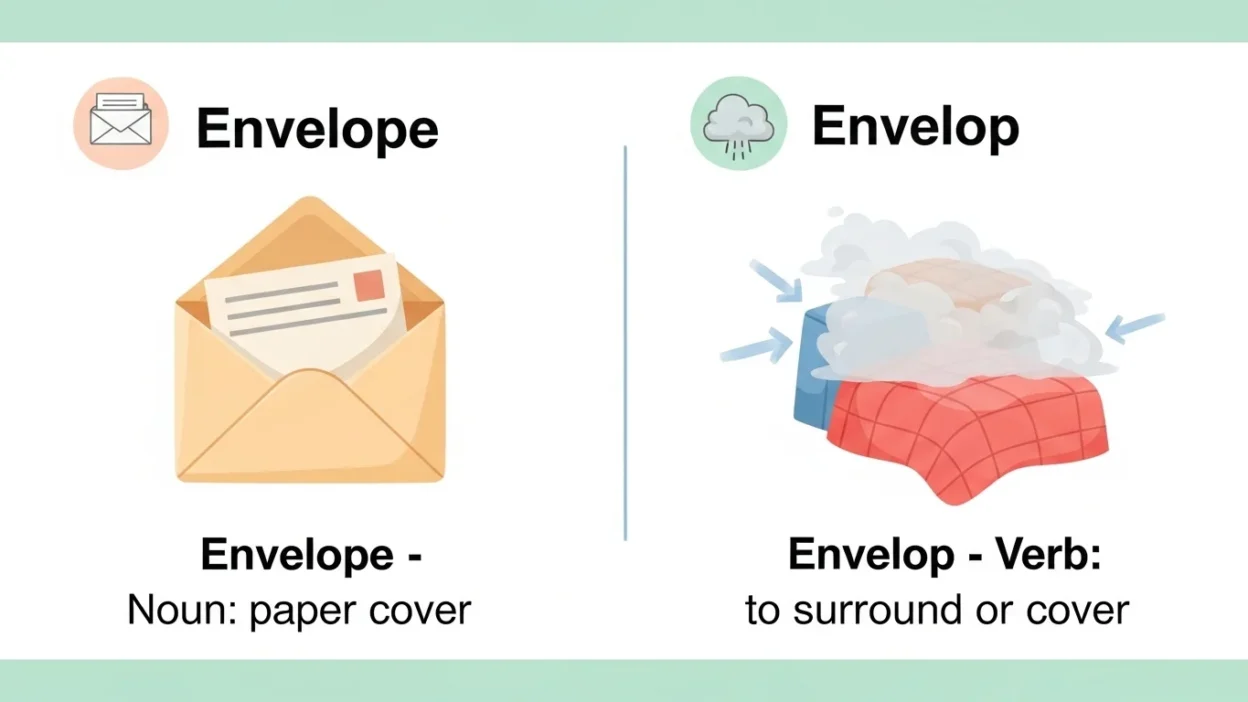
- Envelope → a noun, a paper cover for letters or invitations.
- Envelop → a verb, meaning to wrap, surround, or cover completely.
Memory trick:
- Envelope has an “e” at the end → thing you can touch
- Envelop has no “e” → action is happening
Example Sentences:
- I put the invitation in an envelope.
- Thick fog can envelop the city.
Origins of Envelope and Envelop
Envelope Meaning
- Comes from the French word “enveloppe”, meaning a wrapper or covering.
- Used in English since the 1600s.
Envelop Meaning
- Also comes from the French root, but became a verb in English.
- Means to cover completely or surround something.
So, these words are related but serve different purposes in English.
The Difference Explained
| Word | Part of Speech | Meaning | Example Sentence |
| Envelope | Noun | Paper cover for letters or invitations | I mailed the letter in an envelope. |
| Envelop | Verb | To wrap, cover, or surround completely | Darkness enveloped the entire room. |
Tip for beginners:
- Envelope = thing you can touch
- Envelop = action, something happens
Which One to Use and When
- Use envelope for letters, mail, invitations, or documents.
- Use envelop for fog, smoke, feelings, or anything that wraps or surrounds.
Examples in Sentences:
- She put the birthday card inside an envelope.
- Clouds enveloped the mountain tops.
- You can envelop a gift with wrapping paper.
Common Mistakes
- Writing envelop when you mean envelope
- ❌ Wrong: Put the letter in an envelop.
- ✅ Correct: Put the letter in an envelope.
- ❌ Wrong: Put the letter in an envelop.
- Writing envelope when you mean envelop
- ❌ Wrong: Fog began to envelope the town.
- ✅ Correct: Fog began to envelop the town.
- ❌ Wrong: Fog began to envelope the town.
- Confusing pronunciation
- Envelope = EN-vuh-lope or on-vuh-lope
- Envelop = en-VEL-up
- Envelope = EN-vuh-lope or on-vuh-lope
Everyday Real Life Examples
Emails and Messages:
- “Please put the documents in an envelope before mailing.”
- “A sense of excitement began to envelop her as she opened the letter.”
Social Media Posts:
- “This blanket will envelop you in comfort.”
- “Don’t forget to drop your RSVP in the envelope.”
News Articles:
- “Thick fog enveloped the city yesterday.”
Daily Life:
- Envelope: Mail, invitations, bills
- Envelop: Fog, smoke, feelings, blankets
Mini Quiz for Learners:
Choose the correct word:
- I put my homework in an ______. → (Envelope / Envelop)
- Morning mist ______ the garden. → (Envelope / Envelop)
(Answers: 1. Envelope, 2. Envelop)
Pronunciation Guide
| Word | Pronunciation (IPA) | Tip for ESL learners |
| Envelope | /ˈɛn.və.ləʊp/ or /ˈɑːn.və.ləp/ | Remember the “thing you touch” sound |
| Envelop | /ɪnˈvɛl.əp/ | Stress the second syllable for action |
Fun Memory Tricks
- Envelope = paper → “E” for Envelope, E for External thing
- Envelop = action → No “e,” movement is happening
- Visualize:
- Envelope = Letter inside a paper cover
- Envelop = Mist surrounding a city
- Envelope = Letter inside a paper cover
FAQ Section
1. Can I say “envelop” for letters?
No. Always use envelope for letters or mail.
2. Can “envelop” describe feelings?
Yes. For example, “Fear enveloped him” is correct.
3. What is the plural of envelope?
Envelopes.
4. Do envelope and envelop sound the same?
No. Envelope = EN-vuh-lope, Envelop = en-VEL-up.
5. How can I remember the difference?
Think: Envelope = thing, Envelop = action.
6. Can fog envelop a city?
Yes, that is correct usage.
7. Can I say “I enveloped the card”?
Yes, if you wrapped it completely with something.
8. Is envelope only for mail?
Mostly yes, but it can also mean any paper cover for gifts or invitations.
Short Learning Tips for Students and Learners
- Always look at the word ending: “e” = thing, no “e” = action.
- Practice with mini-exercises and sentences every day.
- Use visuals or flashcards: draw a letter in an envelope, and mist enveloping a city.
- Try saying sentences aloud: it improves pronunciation and memory.
Conclusion
Envelope and envelop look similar but are very different:
- Envelope = noun = paper cover
- Envelop = verb = to cover or surround
Quick tips:
- If it’s something you can touch → envelope
- If it’s something happening → envelop
With the memory tricks, pronunciation guide, mini quizzes, and examples, you now know how to use envelope vs envelop correctly in writing, speaking, and everyday life.