Many people get confused between drier vs dryer. They look almost the same, sound very similar, and both relate to removing water. But they have different meanings.
This guide will explain the difference between drier and dryer clearly, with easy examples, tables, and mini exercises. By the end, you will know exactly when to use each word.
Quick Answer:
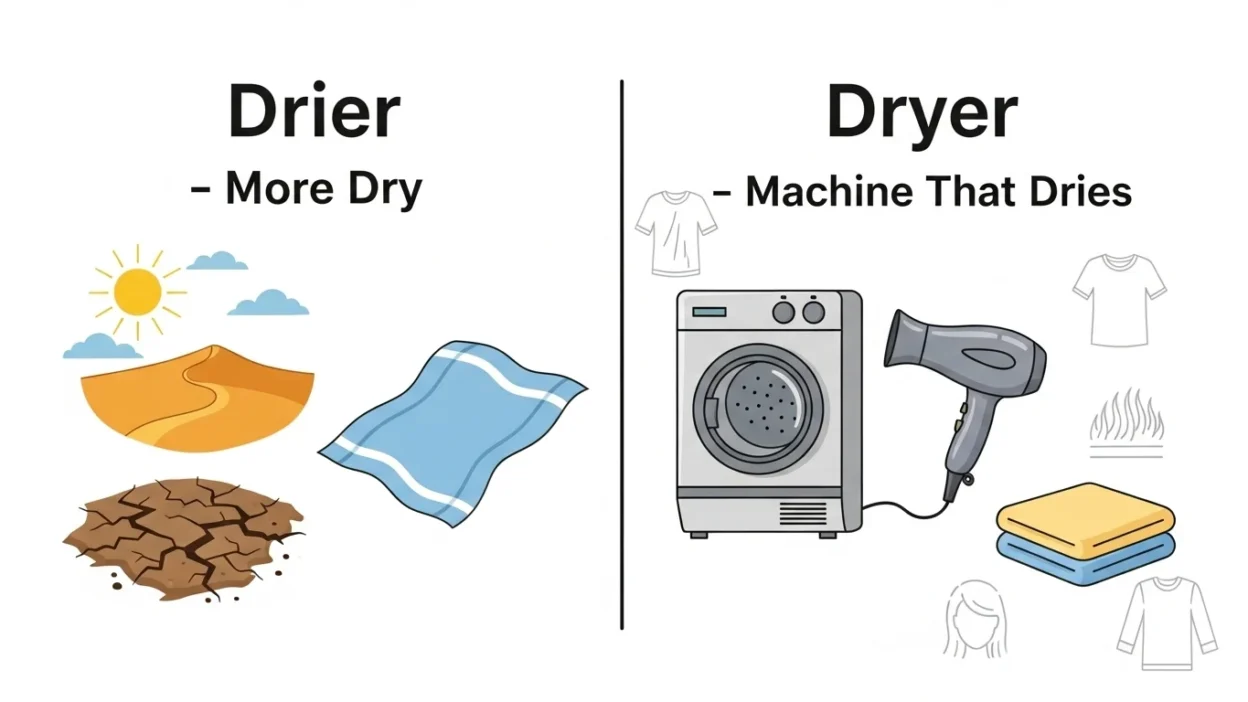
- Drier → adjective: describes something that is more dry.
- Example: “The towel is drier than the shirt.”
- Example: “The towel is drier than the shirt.”
- Dryer → noun: a machine, tool, or person that dries something.
- Example: “I put my clothes in the dryer.”
- Example: “I put my clothes in the dryer.”
Tip: If you can replace the word with “more dry,” use drier. If it is a thing that dries, use dryer.
Why People Get Confused
- Spelling is similar: “drier” vs “dryer.”
- Pronunciation is almost the same.
- Both are related to drying or removing water.
For beginners, ESL learners, and students, small differences can be confusing. But once you learn the rules, it becomes easy.
Origin / Background
- Drier comes from dry + -er, meaning “more dry.” It is always an adjective.
- Dryer comes from dry + -er, meaning a machine or person that dries something. It is a noun.
Think: condition → drier, machine → dryer.
Clear Explanation with Examples
Drier (adjective)
- Describes something less wet or more dry.
- Often used to compare two things.
- Examples:
- “The desert is drier than the forest.”
- “This bread is drier than yesterday’s bread.”
- “My hands feel drier in winter.”
- “The desert is drier than the forest.”
Dryer (noun)
- Refers to a machine or person that removes water.
- Common examples: clothes dryer, hair dryer, towel dryer.
- Examples:
- “I bought a new dryer for my laundry.”
- “Turn on the hair dryer to dry your hair.”
- “The towel dryer is in the bathroom.”
- “I bought a new dryer for my laundry.”
Comparison Table
| Word | Part of Speech | Meaning | Examples |
| Drier | Adjective | More dry; less wet | “The towel is drier than the shirt.” |
| Dryer | Noun | Machine or person that dries | “I put my clothes in the dryer.” |
When to Use Each
- Drier → describing condition
- “The winter air is drier than the summer air.”
- “The winter air is drier than the summer air.”
- Dryer → referring to a machine/person
- “The dryer finished drying my clothes in 30 minutes.”
- “The dryer finished drying my clothes in 30 minutes.”
Quick trick:
- Condition → drier
- Machine → dryer
Common Mistakes
| Mistake | Correction | Note |
| “My skin is dryer than usual.” (if describing condition) | “My skin is drier than usual.” | Use drier for condition |
| “Put the clothes in the drier.” | “Put the clothes in the dryer.” | Use dryer for machine |
| Repeating same examples | Use diverse contexts | Include food, weather, emails, social media, daily life |
Everyday Examples in Different Contexts
Emails / Messages:
- “The floor is much drier after mopping.”
- “Don’t forget to check the dryer before putting in the clothes.”
News / Articles:
- “Farmers worry because this season is drier than last year.”
- “A new dryer model can save energy and time.”
Social Media / Posts:
- “My hair feels so drier after using this shampoo.”
- “Got a new dryer, and laundry day is now easy!”
Daily Life / Food / Weather:
- “This bread is drier than yesterday’s.”
- “The desert has drier air than the forest.”
- “The towel dryer is in the bathroom for quick use.”
Pronunciation & Regional Usage
- Drier: /ˈdraɪ.ər/ → focus on “more dry.”
- Dryer: /ˈdraɪ.ər/ → focus on “machine.”
- Same in American and British English, so no spelling difference.
Mini Exercise: Fill in the Blanks
- My skin feels ______ in winter. (drier / dryer)
- I bought a new ______ for my clothes. (drier / dryer)
- The desert is ______ than the forest. (drier / dryer)
- Please turn on the ______. (drier / dryer)
- This bread is much ______ than yesterday’s. (drier / dryer)
- I need a ______ for my towel after the shower. (drier / dryer)
Answers: 1. drier, 2. dryer, 3. drier, 4. dryer, 5. drier, 6. dryer
FAQ Section
1. Can I use “dryer” to compare dry things?
- No. Use drier to compare conditions.
2. Is “drier” ever a noun?
- No. Drier is always an adjective.
3. Can “dryer” mean a person?
- Yes. A dryer can refer to someone who dries clothes, food, or hair.
4. Are there British vs American English differences?
- No. Both use drier and dryer the same way.
5. How can I remember the difference?
- Condition → drier, Machine → dryer.
6. What is “drier air” vs “dryer air”?
- Drier air → less moisture in the air.
- Dryer air → incorrect if describing condition.
7. Can I say “the drier machine”?
- No. Correct: the dryer machine or just dryer.
8. Are “drier” and “dryer” pronounced the same?
- Almost. Slight difference: drier → “more dry,” dryer → “the machine.”
9. Examples for social media posts
- “My hair feels drier after using this shampoo.”
- “Got a new dryer and laundry day is easy!”
10. How do learners avoid mistakes?
- Always ask: am I describing condition (drier) or machine/person (dryer)?
Conclusion
Now you can confidently use drier vs dryer:
- Drier = more dry → describes a condition.
- Dryer = machine or tool → describes the thing that dries.
Remember: condition → drier, machine → dryer. With the examples, tables, and exercises in this guide, you can avoid common mistakes and write, speak, and understand English correctly.