Many English learners search for the answer to dreamed vs dreamt because both words appear in books, articles, and everyday conversation. Seeing two different past forms of the same verb can feel confusing.
People often ask questions like:
- Is dreamed or dreamt correct?
- What is the past tense of dream?
- Is dreamt used in American English?
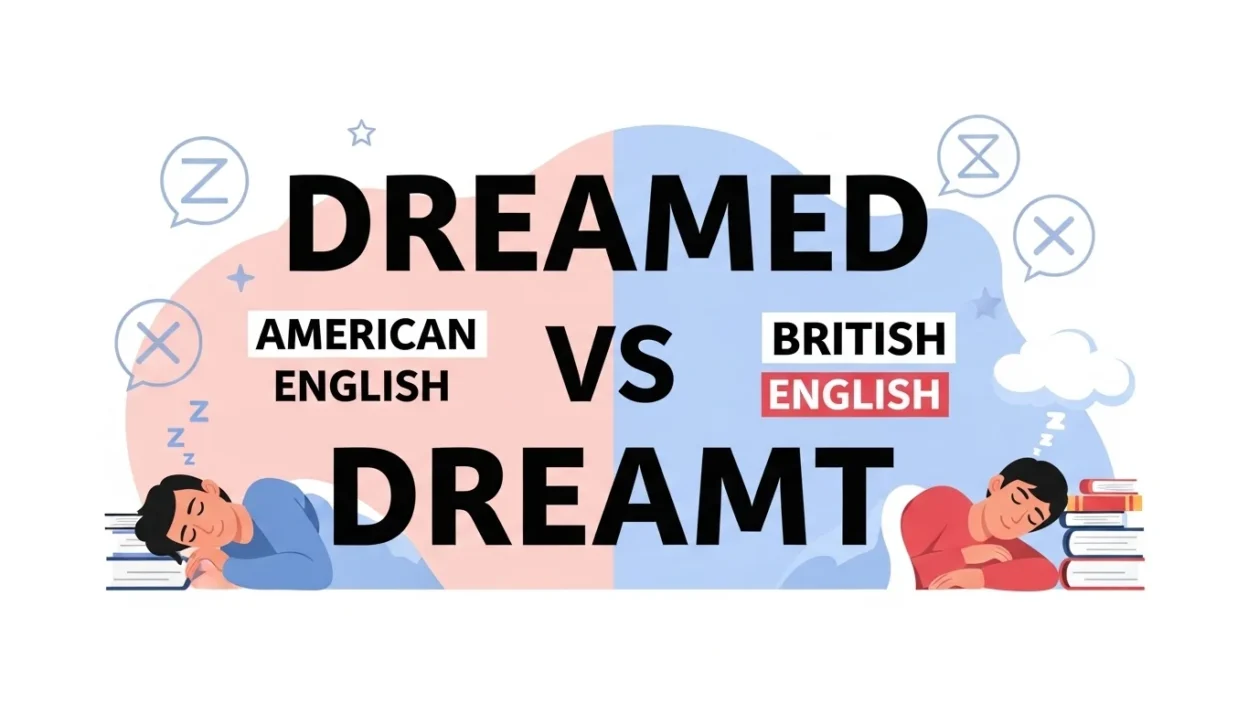
The simple truth is that both dreamed and dreamt are correct. They have the same meaning and the same grammar function. The main difference is how often each form is used in different parts of the world.
This guide explains the difference between dreamed and dreamt, their meaning, grammar rules, examples, and when you should use each form.
Quick Answer
If you want a quick explanation of dreamed vs dreamt, here is the answer:
- Dreamed and dreamt are both the past tense of dream.
- They have the same meaning in English.
- Both can also be used as the dream past participle.
- Dreamed is more common in American English.
- Dreamt is more common in British English.
- Both forms are correct in formal and informal writing.
So if you are wondering dreamed vs dreamt which is correct, the answer is both are correct.
What Is the Past Tense of Dream?
The verb dream describes an experience in your mind while sleeping or imagining something strongly.
Like many verbs, dream changes form when talking about the past.
Present tense:
- I dream every night.
Past tense:
- I dreamed about flying.
- I dreamt about flying.
Both sentences use the correct dream verb past tense.
The verb dream is unusual because it has two accepted past forms.
Dreamed vs Dreamt Meaning
If you compare the dreamed vs dreamt meaning, you will see there is no difference.
Both words mean:
- Something you experienced in your mind while sleeping.
- Something you imagined or hoped for strongly.
Example sentences:
- I dreamed about traveling the world.
- I dreamt about traveling the world.
The message in both sentences is identical.
Dreamed vs Dreamt Grammar Explanation
Understanding dreamed vs dreamt grammar becomes easy once you know how English verbs work.
English verbs often form the past tense by adding -ed.
Examples:
- walk → walked
- talk → talked
- dream → dreamed
However, some verbs also have an older -t ending.
Examples:
- learn → learnt
- burn → burnt
- dream → dreamt
Because both forms developed over time, English now accepts both versions of the dream past tense.
Regular vs Irregular Verb Pattern
The verb dream is interesting because it sits between regular and irregular verbs.
Regular pattern:
- dream → dreamed
Alternative pattern:
- dream → dreamt
This happens with several English verbs.
Examples:
| Present | American Form | British Form |
| learn | learned | learnt |
| burn | burned | burnt |
| spell | spelled | spelt |
| dream | dreamed | dreamt |
These variations are normal in English grammar.
Dreamed vs Dreamt Comparison Table
| Feature | Dreamed | Dreamt |
| Meaning | Same meaning | Same meaning |
| Verb type | Past tense & past participle | Past tense & past participle |
| American English | Very common | Less common |
| British English | Common | Very common |
| Formal writing | Correct | Correct |
| Informal writing | Correct | Correct |
This table shows that the difference between dreamed and dreamt is mainly about language preference, not grammar.
Dreamed vs Dreamt in American vs British English
Another important part of dreamed vs dreamt usage is regional preference.
American English
In the United States, dreamed is used more often.
Example:
- She dreamed about becoming a doctor.
Most American books, newspapers, and school materials prefer this form.
British English
In the United Kingdom, dreamt appears more frequently, although dreamed is still correct.
Example:
- He dreamt of living near the ocean.
This difference is why English learners often see both forms.
When Should You Use Dreamed?
You can use dreamed in these situations:
- Writing in American English
- Academic essays in American schools
- Professional or formal writing that prefers regular verbs
Examples of dreamed vs dreamt examples:
- I dreamed about my childhood home.
- She dreamed of becoming a singer.
- They dreamed about their future careers.
Because it follows the normal -ed pattern, many learners find it easier to remember.
When Should You Use Dreamt?
You can use dreamt in these situations:
- Writing in British English
- Informal conversation in the UK
- Creative writing and storytelling
Examples:
- I dreamt about flying last night.
- He dreamt of a peaceful life.
- She dreamt about meeting her favorite actor.
Both forms work perfectly in everyday English.
Dreamed vs Dreamt in Sentences
Here are some everyday dreamed vs dreamt in sentences used in different situations.
Daily Conversation
- I dreamed about the beach last night.
- I dreamt about the beach last night.
Both sound natural.
Emails
- I dreamed about our travel plans.
- I dreamt about our upcoming vacation.
Social Media
- I dreamed of visiting new countries.
- I dreamt about my childhood memories.
News and Articles
- The athlete dreamed of winning a gold medal.
- The writer dreamt of publishing a successful book.
These examples show that both forms work in real communication.
Common Mistakes with Dreamed vs Dreamt
Learners sometimes make mistakes when using the dream past tense.
1. Thinking One Form Is Incorrect
Some people believe dreamt is wrong. This is not true.
Both forms are correct English.
2. Mixing Both Forms in One Text
Example:
- I dreamed about my exam yesterday. Later I dreamt about my teacher.
This is not technically wrong, but it can look inconsistent.
It is better to choose one style and keep it the same.
3. Using the Wrong Verb Form
Incorrect:
- I dream about it last night.
Correct:
- I dreamed about it last night.
- I dreamt about it last night.
Simple Learning Tips for Students and Beginners
If you are learning English grammar, remember these simple rules.
Rule 1
Dreamed = Dreamt
Both words mean the same thing.
Rule 2
Both forms are the past tense of dream.
Rule 3
Both can be used as the dream past participle.
Example:
- I have dreamed of success.
- I have dreamt of success.
Rule 4
Choose one style and use it consistently in writing.
FAQ: Dreamed vs Dreamt
1. Is dreamt correct in English?
Yes. Many people ask is dreamt correct, and the answer is yes. It is a standard English word.
2. Is dreamed correct?
Yes. If you ask is dreamed correct, the answer is also yes. It is the most common form in American English.
3. Is dreamt used in American English?
Yes, but it is less common. Americans usually prefer dreamed.
4. Do dreamed and dreamt have different meanings?
No. The dreamed vs dreamt meaning is exactly the same.
5. Can dreamt be used in formal writing?
Yes. Both forms are correct in formal and informal writing.
6. Why does English have two past tense forms?
English developed over many centuries, and some verbs kept two past forms.
Examples include:
- learned / learnt
- burned / burnt
- spelled / spelt
7. Which form should English learners use?
Both forms are correct, but many learners choose dreamed because it follows the regular -ed rule.
Conclusion
Understanding dreamed vs dreamt is easier than it first appears.
Both words are correct forms of the dream past tense and dream past participle. They have the same meaning and the same grammatical use.
The only real difference is regional preference:
- Dreamed is more common in American English.
- Dreamt is more common in British English.
If you remember one simple rule, remember this:
Both forms are correct, just choose one and use it consistently in your writing.