Many people get confused between disorganized and unorganized. Both words look similar and talk about things that are messy or unordered, but they are not the same. This confusion is very common for students, learners and beginners.
In this article, you will learn the difference between disorganized and unorganized, see many real life examples, and get easy tips for using these words correctly in daily life, emails, school, and work.
Why People Get Confused
- Both words describe things that are not arranged properly.
- They can sound similar, so people sometimes use them interchangeably, which is incorrect.
- Understanding the difference will help you write, speak, and communicate clearly in English.
Quick Answer: The Main Difference
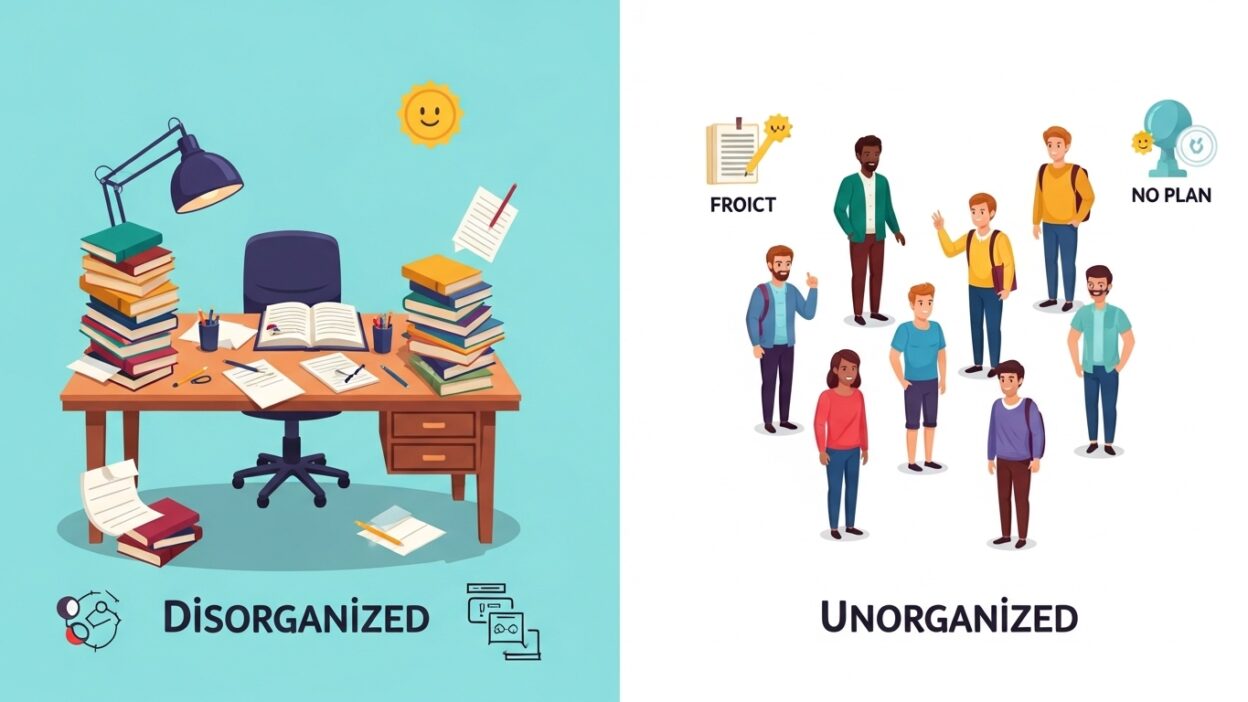
- Disorganized ✅
- Was organized or could be organized but is now messy or chaotic.
- Example: “Her desk is disorganized after the meeting.”
- Was organized or could be organized but is now messy or chaotic.
- Unorganized ❌
- Was never organized; there is no system from the start.
- Example: “The volunteer group is unorganized because they have no plan.”
- Was never organized; there is no system from the start.
Origins and Simple Background
- Dis- means “not” or “opposite of” (e.g., disagree, dislike).
- Un- also means “not” or “opposite of” (e.g., unhappy, uncooked).
Both prefixes mean “not,” but in words about organization, they are used differently.
Clear Explanation of the Difference
- Disorganized
- Refers to something that was organized before but is now messy or unstructured.
- Commonly used for people, desks, rooms, schedules, or files.
- Shows a change from order to disorder.
- Refers to something that was organized before but is now messy or unstructured.
- Unorganized
- Refers to something that was never organized.
- Often used for groups, teams, events, or plans.
- Shows the absence of structure from the beginning.
- Refers to something that was never organized.
Comparison Table
| Feature | Disorganized | Unorganized |
| Meaning | Was organized, now messy or unstructured | Never organized |
| Use | People, desks, rooms, schedules, files | Groups, teams, events, plans |
| Example Sentence | “Her closet is disorganized after the party.” | “The project team is unorganized because there is no leader.” |
| Suggests Change | Yes (from order to disorder) | No (never had order) |
| Tone | Can suggest temporary chaos or mess | Suggests permanent lack of structure |
| Real-Life Focus | Personal items, workspaces, ideas | Teams, projects, events |
When to Use Each Word
- Use disorganized when:
- Talking about a messy room, desk, schedule, or files
- Describing a person who forgets things or is chaotic
- Something was organized before but is messy now
- Talking about a messy room, desk, schedule, or files
- Use unorganized when:
- Talking about groups, teams, or events that have no system
- Referring to plans or projects that never had structure
- Something never had order or rules
- Talking about groups, teams, or events that have no system
Actionable Tips for Students & Beginners
- Tip 1: Ask yourself, “Was it ever organized?”
- Yes → disorganized
- No → unorganized
- Yes → disorganized
- Tip 2: Think of the subject:
- People or personal items → usually disorganized
- Groups, projects, events → usually unorganized
- People or personal items → usually disorganized
- Tip 3: Practice with sentences:
- “My backpack is ___.” → disorganized
- “The charity event is ___.” → unorganized
- “My backpack is ___.” → disorganized
- Tip 4: Use disorganized for emails, schoolwork, essays, and files
- Tip 5: Use unorganized for teams, clubs, online events, or group plans
Common Mistakes to Avoid
- ❌ “The files are unorganized.” → ✅ Correct: “The files are disorganized.”
- ❌ “Our class is disorganized because we never had a plan.” → ✅ Correct: “Our class is unorganized because we never had a plan.”
- Confusing them in emails, reports, or essays can make your English unclear.
Real Life Examples
- Emails:
- “Sorry for the late reply, my inbox is completely disorganized.”
- “The volunteer group is unorganized, we need a coordinator.”
- “Sorry for the late reply, my inbox is completely disorganized.”
- School & Work:
- “His notebook is disorganized, I can’t find the notes.”
- “The student council is unorganized, there is no schedule.”
- “His notebook is disorganized, I can’t find the notes.”
- Social Media:
- “My photo gallery is totally disorganized 😅”
- “The online game event was unorganized, nobody knew the rules 😬”
- “My photo gallery is totally disorganized 😅”
- Daily Life:
- Disorganized: Desk, room, schedule, ideas
- Unorganized: Team, project, event, volunteer group
- Disorganized: Desk, room, schedule, ideas
Extra Practice Table for Learners
| Sentence | Fill in the blank | Correct Word |
| My desk is very ___ after the party. | ___ | disorganized |
| The charity committee is completely ___. | ___ | unorganized |
| His schedule became ___ after exams. | ___ | disorganized |
| The football team is still ___. | ___ | unorganized |
| Her essay is ___ and hard to read. | ___ | disorganized |
FAQ Section
1. Can “disorganized” and “unorganized” be used together?
- Usually no. They describe different situations.
2. Is a disorganized person lazy?
- Not necessarily. It just means messy or forgetful.
3. Can a group be disorganized?
- Yes, but only if it had order before and now is chaotic.
4. Can an unorganized event become organized?
- Yes, with planning, rules, and structure.
5. Which word is more common for students?
- Disorganized is more common for personal items.
- Unorganized is more common for teams and group activities.
6. Are these words formal or informal?
- Both are neutral and can be used in formal and informal English.
7. Can disorganized describe ideas?
- Yes. “His essay is disorganized.”
8. Can unorganized describe ideas?
- Rarely. It usually refers to groups, projects, or events.
9. Tips to remember:
- Think personal vs group and was it organized before?
Conclusion
- Disorganized = was organized, now messy or unstructured.
- Unorganized = never organized, no system from the start.
By practicing with real life examples, emails, schoolwork, and daily life, you can confidently use these words in your writing and speaking.
Use the tables, examples, and tips in this article to improve your English quickly!