Many students, beginners, and learners often mix up die vs dye.
Even though they sound the same, they mean very different things.
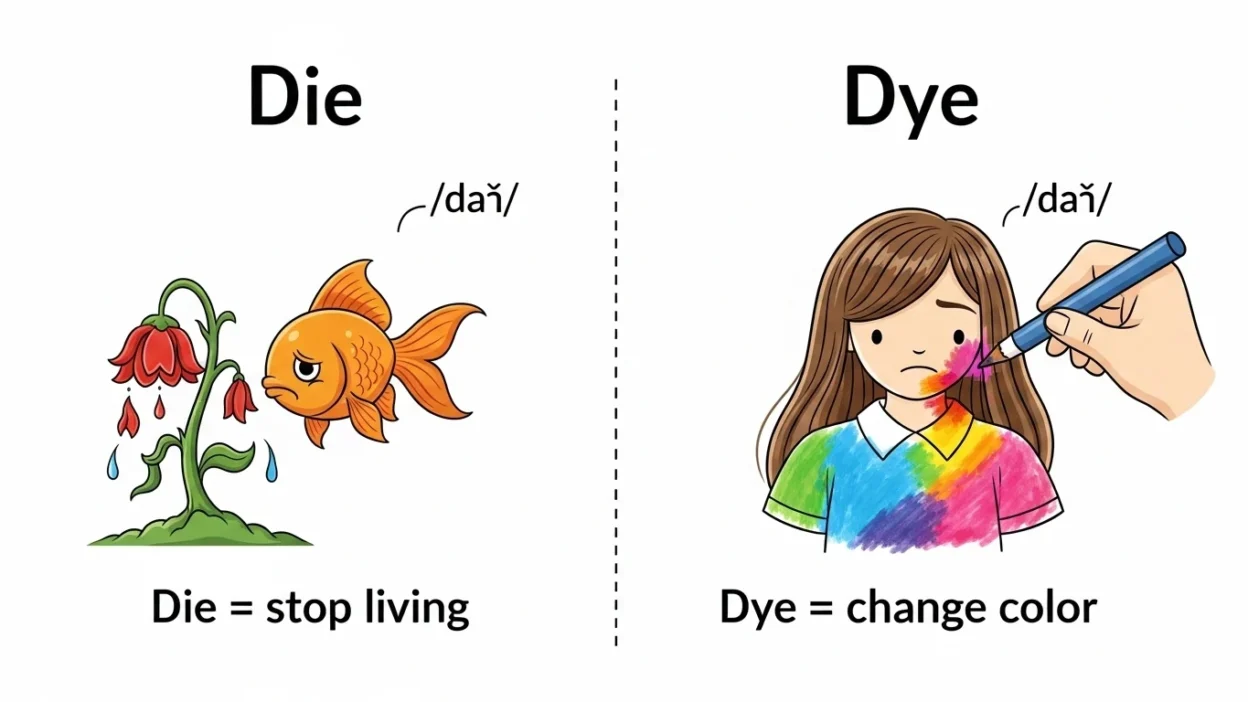
- Die → life ends
- Dye → change color
People get confused because English has many words that sound alike. This guide will explain the difference between die and dye, give examples, and help you use them correctly in daily life, emails, and social media.
Quick Answer: Die vs Dye
- Die /daɪ/ → to stop living
- Example: “My goldfish died last week.”
- Tip: Think of life ending → no ‘y’.
- Example: “My goldfish died last week.”
- Dye /daɪ/ → to change the color of something
- Example: “I want to dye my hair red.”
- Tip: Think of color → has ‘y’.
- Example: “I want to dye my hair red.”
Quick memory trick: ‘Y’ in dye → color, no ‘Y’ in die → life ends.
Origin or Background
- Die comes from Old English “deegan”, meaning to stop living.
- Dye comes from Old English “deag”, meaning a substance for coloring clothes or materials.
Even though they sound the same, their meanings are completely different.
Clear Explanation of the Difference
- Die = stop living → Use for people, animals, plants, or machines that stop working.
- Dye = change color → Use for clothes, hair, fabric, or art projects.
Phonetic reminder: Both are pronounced /daɪ/, so always look at context.
Memory trick:
- Life ends → die → no ‘y’
- Color → dye → has ‘y’
Comparison Table with Real Examples
| Word | Meaning | Example | Daily Life Example | Tip to Remember |
| Die | To stop living | “My dog died last year.” | “Plants die without water.” | Life ends → no ‘y’ |
| Dye | To change color | “She dyed her shirt blue.” | “I dyed my hair pink today.” | Color → has ‘y’ |
| Die | Stop working | “The battery died.” | “My old phone died yesterday.” | Life/energy ends → no ‘y’ |
| Dye | Coloring material | “Use red dye for fabric.” | “We need black dye for the project.” | Substance for color → has ‘y’ |
Which One to Use and When
- Use Die:
- When talking about death of people, animals, or plants.
- When something stops working (machines, batteries).
- Metaphorical endings: “That old tradition will die soon.”
- When talking about death of people, animals, or plants.
- Use Dye:
- When coloring hair, clothes, or fabrics.
- In art, craft, or DIY projects.
- When coloring hair, clothes, or fabrics.
Common Mistakes People Make
- ❌ “I want to die my hair.” → ✅ “I want to dye my hair.”
- ❌ “The flowers will dye if not watered.” → ✅ “The flowers will die if not watered.”
- Confusing pronunciation → Always focus on context to decide meaning.
Tip: If it’s about life or stopping → die. If it’s about color → dye.
Everyday Real Life Examples
Emails
- ✅ “I am sad that our class pet died.”
- ✅ “I dyed my old shirt green and it looks great.”
Social Media
- ✅ “My grandma’s flowers died because of the heat.”
- ✅ “Just dyed my hair pink! 💖”
News
- ✅ “Many plants died due to drought.”
- ✅ “The company dyed the uniforms blue for the new season.”
Daily Life
- ✅ “Don’t forget to water your plants, or they will die.”
- ✅ “We will dye the curtains red to match the room.”
Mini Practice Section for Students
Try filling the blanks:
- My phone ______ yesterday. (die / dye) → die
- I want to ______ my socks yellow. (die / dye) → dye
- Flowers will ______ without water. (die / dye) → die
- She ______ her hair black last week. (die / dye) → dye
Answer key: 1-die, 2-dye, 3-die, 4-dye
Practice helps die vs dye meaning stick in your memory.
FAQ (Simple Questions)
Q1: Can “die” ever mean color?
- No, die always means to stop living or stop working.
Q2: Can “dye” be used for animals or people?
- Yes, for coloring hair or fur. Not for life ending.
Q3: How do I remember the difference?
- ‘Y’ in dye → color. No ‘Y’ in die → life ends.
Q4: Are they pronounced differently?
- No, both sound /daɪ/. Context decides meaning.
Q5: Can “die” be used for machines?
- Yes. Example: “My battery died.”
Q6: Can “dye” be a noun?
- Yes. Example: “This dye is blue.”
Q7: Is it common to confuse them?
- Yes, even native speakers mix them up.
Q8: Can “die” be used metaphorically?
- Yes. Example: “That old idea will die soon.”
Conclusion
Now you can confidently use die vs dye:
- Die → life ends or stops working
- Dye → color changes
Memory trick: ‘Y’ → color (dye), no ‘Y’ → life ends (die).
Practice with examples, mini exercises, and real life situations. Soon, even beginners and learners can use die vs dye correctly every time.