Quick Answer: Continuous Continuing
- Continuous – something never stops; unbroken.
- Continuing – something still happening; may have pauses.
Examples:
- Continuous: The rain was continuous all night. 🌧️
- Continuing: She is continuing her studies after high school. 🎓
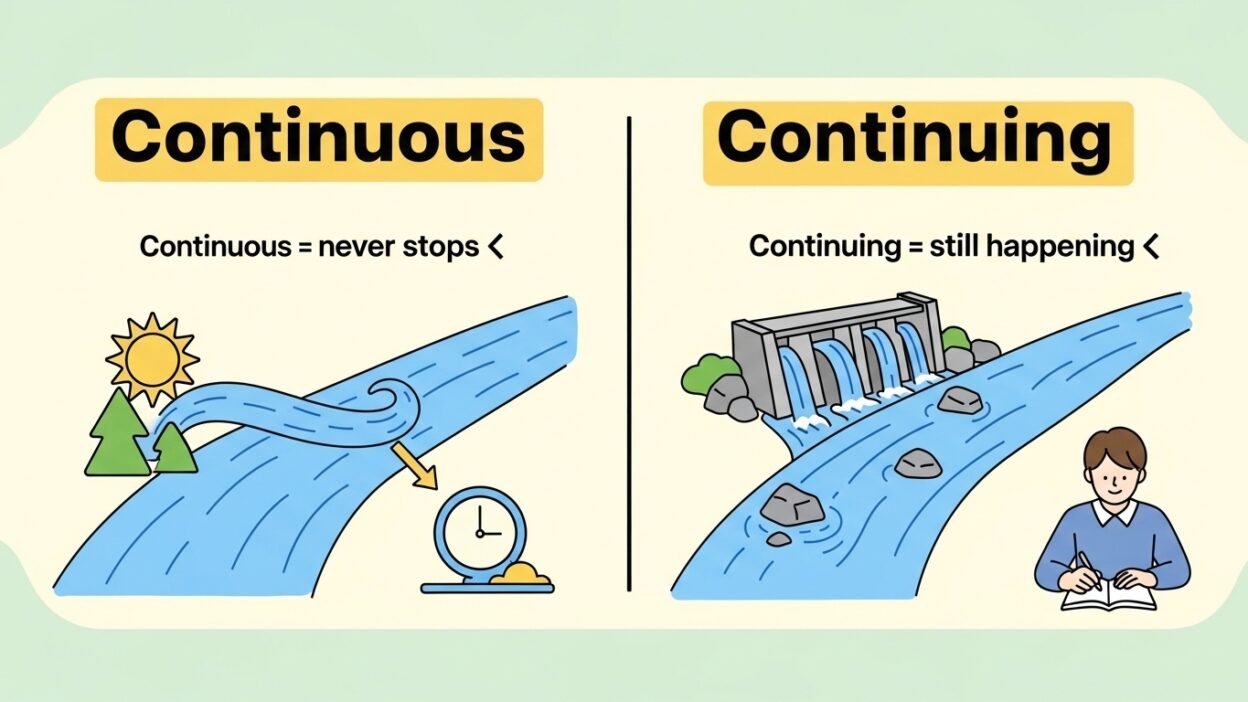
Memory tip: Continuous = unbroken like a river 🌊. Continuing = still flowing, even if it pauses 💧.
Many students and learners confuse continuous vs continuing because both words come from the verb “continue”.
They both describe things that go on, but they are used differently. Choosing the wrong word can make a sentence confusing.
This guide explains the difference between continuous and continuing in English in very simple words, with examples, tables, and tips to make it easy to remember.
Where These Words Come From
- Both words come from the verb “continue”, meaning “to keep going.”
- Continuous → Latin “continuus” → unbroken or nonstop.
- Continuing → -ing form of “continue,” showing an ongoing action.
Simple rule:
- Continuous = never stops
- Continuing = still happening
Clear Explanation: Continuous vs Continuing
1. Continuous
- Definition: Something unbroken, nonstop.
- Part of speech: Adjective.
- Use: For conditions, events, or states that never pause.
Examples:
- The continuous noise from construction bothered everyone. 🔊
- Continuous traffic made us late. 🚗
- Continuous rainfall caused flooding in the city. 🌧️
2. Continuing
- Definition: Something still happening, even if it pauses sometimes.
- Part of speech: Verb (or adjective).
- Use: For actions, studies, projects, or problems that are ongoing.
Examples:
- She is continuing her work despite the delay. 💼
- The continuing problem with the internet needs fixing. 🌐
- He is continuing his journey to learn Spanish. 🇪🇸
Continuous vs Continuing: Easy Comparison Table
| Feature | Continuous | Continuing |
| Meaning | Unbroken, nonstop | Still happening, ongoing |
| Part of Speech | Adjective | Verb / Adjective |
| Stops or Pauses? | Never stops | May pause but not finished |
| Example Situation | Rain, noise, events | Studies, problems, projects |
| Time Reference | Specific period | Present or ongoing action |
| Example Sentence | The continuous beep was annoying. 🔔 | He is continuing to learn English. 📖 |
When to Use Continuous or Continuing
Use Continuous
- For things that never stop.
- Often used for nature, events, or conditions.
Examples:
- The continuous hum of the fan helped me sleep. 💤
- She has had continuous success in her career. 🏆
- Continuous notifications from my phone are annoying. 📱
Use Continuing
- For things still happening, even if there are pauses.
- Often used for actions, studies, projects, or problems.
Examples:
- He is continuing his research at the university. 🔬
- The continuing rain may cause floods tomorrow. 🌧️
- I am continuing my workout routine at home. 🏋️
Common Mistakes Learners Make
- Using continuous for actions that can pause.
- ❌ Wrong: She has a continuous problem with her car.
- ✅ Correct: She has a continuing problem with her car.
- ❌ Wrong: She has a continuous problem with her car.
- Using continuing for things that are nonstop.
- ❌ Wrong: The continuing noise was unbearable.
- ✅ Correct: The continuous noise was unbearable.
- ❌ Wrong: The continuing noise was unbearable.
- Confusing adjectives and verbs in sentences.
Tip: Ask yourself:
- “Does it never stop?” → Continuous
- “Is it still happening?” → Continuing
Everyday Examples: Continuous vs Continuing in Daily English
Emails
- Continuous: “We experienced continuous technical issues yesterday.” 💻
- Continuing: “We are continuing to improve our website.” 🌐
News
- Continuous: “Continuous rainfall caused flooding in the city.” 🌧️
- Continuing: “The continuing conflict affects thousands of people.” 📰
Social Media & Conversations
- Continuous: “Continuous notifications are drive one to their limit!” 📱
- Continuing: “Continuing my journey to learn Spanish. 🇪🇸💪”
Short Learning Section for Students and Beginners
- Step 1: If it never stops, use continuous.
- Step 2: If it is still happening, use continuing.
- Step 3: Check if it’s an adjective or verb.
- Step 4: Practice with short sentences:
- Continuous: “The sun shone continuously.” ☀️
- Continuing: “I am continuing my homework.” 📝
- Continuous: “The sun shone continuously.” ☀️
Fun mnemonic:
Continuous = river never stops 🌊
Continuing = river keeps flowing even if paused 💧
FAQ: Continuous vs Continuing
1. Can continuous and continuing be used interchangeably?
- No. Continuous = never stops. Continuing = still happening.
2. Is “continuous learning” correct?
- Yes. It means learning without breaks.
3. Is “continuing learning” correct?
- Yes. It means learning is still happening.
4. Can continuous describe actions?
- Usually no. It describes states or conditions.
5. Can continuing be used as an adjective?
- Yes. Example: “The continuing problem is difficult to solve.”
6. Can I use continuing for events that already stopped?
- No. Use it only for things still happening.
7. How to remember the difference?
- Continuous = never stops
- Continuing = still happening
8. Are there conversational examples?
- Continuous: “The continuous noise from the street kept me awake.”
- Continuing: “I am continuing my English practice every day.”
Conclusion
Understanding continuous vs continuing is simple:
- Continuous → never stops, unbroken.
- Continuing → still happening, may pause.
By using short sentences, examples from emails, news, social media, and daily conversations, plus the mnemonic tip, beginners can remember the difference easily.
Practice these examples daily, and soon using continuous vs continuing in English will feel natural.