Many students and English learners feel confused about breath vs breathe. These words look almost the same and both relate to air and breathing.
Here’s the quick, clear answer for instant understanding:
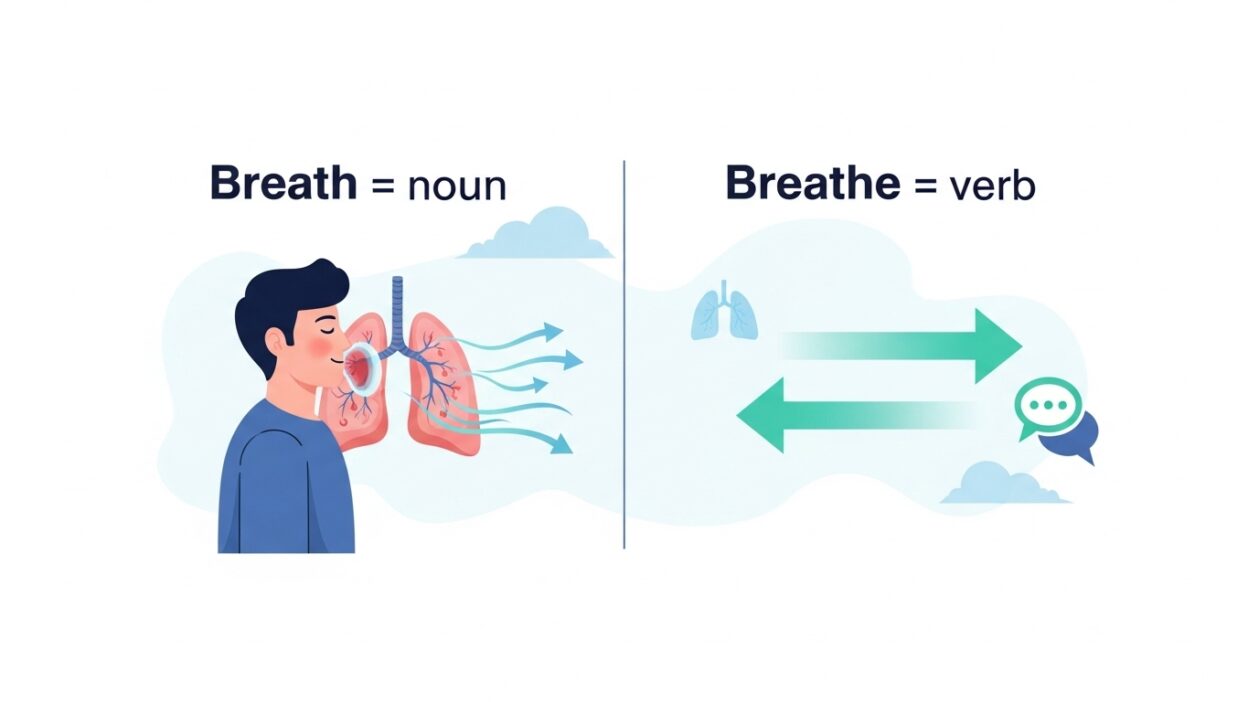
Breath is a noun (a thing, the air you take in or let out).
Breathe is a verb (an action, the act of taking air in and out).
Once you know this simple rule, you will never confuse them again.
Quick Answer
- Breath → noun → the air in your lungs
- Example: Take a deep breath.
- Example: Take a deep breath.
- Breathe → verb → the action of taking air in and out
- Example: Remember to breathe slowly.
- Example: Remember to breathe slowly.
Memory tip: The extra “e” in breathe reminds you it is an action word.
Pronunciation Difference
Many learners mix up pronunciation too:
| Word | Pronunciation | Tip |
| Breath | /breθ/ | soft “th,” short |
| Breathe | /briːð/ | long “ee” + vibrating “th” |
Practice saying both aloud. It helps you remember which is noun and which is verb.
Origin and Background
Both words come from the same Old English root related to air and breathing.
- Breath developed as the noun → the air itself.
- Breathe developed as the verb → the action of inhaling and exhaling.
The small extra “e” in breathe is your clue that it’s an action word.
Breath Meaning and Examples
Breath = noun = air in your lungs.
Examples:
- Take a deep breath before your speech.
- Her breath smelled like coffee.
- He held his breath during the scary scene.
- After running, I needed a moment to catch my breath.
Common phrases with breath:
- Take a breath
- Hold your breath
- Catch your breath
Breathe Meaning and Examples
Breathe = verb = the act of taking air in and out.
Examples:
- Try to breathe slowly.
- I cannot breathe well in polluted air.
- After running, it is hard to breathe normally.
- Remember to breathe deeply during meditation.
Common phrases with breathe:
- Breathe deeply
- Breathe slowly
- Breathe fresh air
Breath vs Breathe: Comparison Table
| Feature | Breath | Breathe |
| Part of speech | Noun | Verb |
| Meaning | The air you take in or let out | The action of inhaling and exhaling |
| Example | Take a deep breath | Try to breathe slowly |
| Spelling tip | No “e” → thing | Extra “e” → action |
Which One to Use and When
Use breath when talking about the air itself:
- I needed a moment to catch my breath.
- She held her breath in surprise.
- Take a deep breath before starting.
Use breathe when talking about the action of breathing:
- Step outside and breathe some fresh air.
- Try to breathe slowly and relax.
- I couldn’t breathe because of the smoke.
Quick trick:
- Can you replace it with “take air”? → use breathe.
- Can you replace it with “a bit of air”? → use breath.
Common Mistakes
- Using breath as a verb
❌ Please breath slowly.
✅ Correct: Please breathe slowly. - Using breathe as a noun
❌ Take a deep breathe.
✅ Correct: Take a deep breath. - Forgetting the “e” in breathe
❌ I cannot breath properly.
✅ Correct: I cannot breathe properly.
Everyday Examples
Emails
- I needed a moment to catch my breath after the meeting.
- Step outside and breathe some fresh air.
Conversations
- Take a deep breath.
- Just breathe slowly.
Social Media
- “Remember to breathe and stay calm.”
- “Finally took a deep breath after exams.”
Health Advice
- Breathe clean air for better health.
- After exercise, your breath becomes faster.
Practice Exercises
Fill in the blanks with breath or breathe:
- Take a deep ______ before you start speaking.
- Remember to ______ slowly when you are stressed.
- She held her ______ while waiting for the results.
- I could not ______ properly because of the dust.
- After running, he needed to catch his ______.
Answers: 1. breath | 2. breathe | 3. breath | 4. breathe | 5. breath
Learning Tips for Students and Beginners
- Remember the grammar rule:
- Breath = noun
- Breathe = verb
- Breath = noun
- Extra “e” tip:
- Breathe = action → think E = energy/action
- Breathe = action → think E = energy/action
- Practice sentences aloud:
- Take a deep breath
- Try to breathe slowly
- Hold your breath
- Breathe fresh air
- Take a deep breath
- Listen and repeat: pronunciation helps ESL learners differentiate.
Frequently Asked Questions (FAQ)
- What is the main difference between breath and breathe?
Breath = noun; Breathe = verb (action). - How do I know which one to use?
Use breath for the air, breathe for the action. - What does breath mean?
The air that goes in or out of your lungs. - What does breathe mean?
The action of inhaling and exhaling air. - Can they appear in the same sentence?
Yes: Take a deep breath and breathe slowly. - How do I remember the difference easily?
Extra “e” = action → breathe. No “e” → noun → breath. - Is pronunciation important?
Yes. Breath = /breθ/ (soft), Breathe = /briːð/ (long “ee”). - Are these common mistakes for students?
Yes. Many learners confuse them in writing and speaking.
Conclusion
The difference between breath vs breathe is simple:
- Breath → noun → the air
- Breathe → verb → the action of taking air in and out
Memory tip: Breathe has an extra “E” → action word.
Practice examples, exercises, and pronunciation, and you will never confuse them again. Take a deep breath… and now breathe confidently!