English learners, students, and even native speakers often get confused about any time vs anytime.
They sound almost the same, but their use is different. Understanding the difference between any time and anytime will make your writing and speaking clearer.
This guide explains when to use any time or anytime, gives simple examples, and includes exercises for beginners.
Why People Get Confused
- Both any time and anytime sound the same.
- One is two words (any time) and one is one word (anytime).
- The confusion usually comes from not knowing any time or anytime correct usage.
Quick tip: If you can replace it with “whenever”, it is probably anytime.
Quick Answer: Any Time vs Anytime
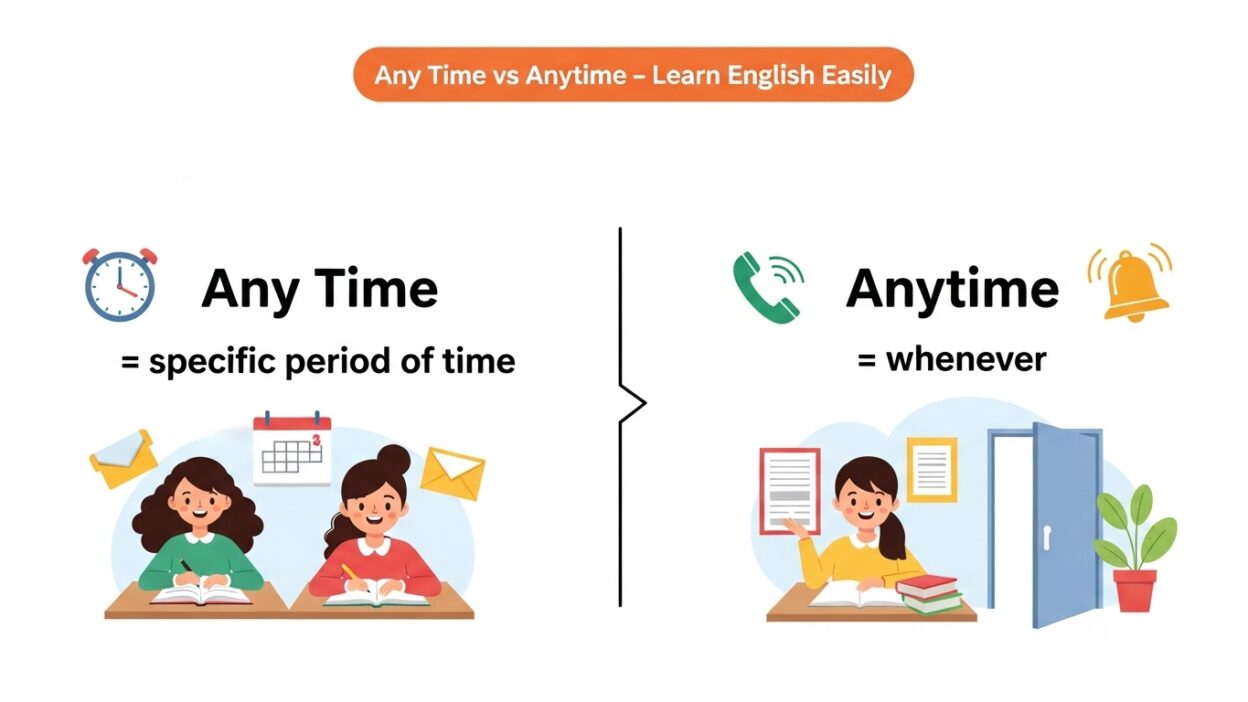
- Any time (two words) – means a specific amount of time.
- Anytime (one word) – means whenever or at any moment.
Examples:
- “Do you have any time today?” → specific time.
- “You can call me anytime.” → whenever you want.
Pronunciation note: Both sound the same: /ˈeni taɪm/ → context tells the difference.
Flowchart to Decide Quickly
Do you mean a specific amount of time?
│
├─ Yes → any time
│ (I don’t have any time now.)
│
└─ No → anytime
(Call me anytime you want.)
Clear Explanation
1. Any Time (Two Words)
- Two words: any + time
- Noun phrase
- Talks about specific period or amount of time
Examples:
- “I don’t have any time to eat lunch.”
- “Do you have any time tomorrow?”
- “She spent any time she could studying for the exam.”
2. Anytime (One Word)
- One word, an adverb
- Means “whenever” or “at any moment”
Examples:
- “You can text me anytime.”
- “We are open anytime for visitors.”
- “I don’t expect it anytime soon.”
Comparison Table
| Feature | Any Time (2 words) | Anytime (1 word) |
| Part of Speech | Noun phrase | Adverb |
| Meaning | Specific period or amount of time | Whenever / at any moment |
| Example 1 | “I don’t have any time now.” | “You can text me anytime.” |
| Example 2 | “Do you have any time tomorrow?” | “Visit us anytime you like.” |
| Common Use | Formal, questions about availability | Casual, general offers |
When to Use Each
Use “any time” when:
- Asking about time someone has
- Talking about a specific period
Use “anytime” when:
- Saying whenever is okay
- Giving general permission or offers
Tip: Replace with “whenever” → if it works, use anytime.
Common Mistakes
- ❌ “Do you have anytime tomorrow?” → wrong
✅ “Do you have any time tomorrow?” - ❌ “You can visit us at any time.” → formal, but often casual
✅ “You can visit us anytime.” - ❌ Mixing both in one sentence
❌ “Do you have anytime to help me anytime?”
✅ “Do you have any time to help me? You can call me anytime.”
Everyday Real Life Examples
Emails
- “Please let me know if you have any time to meet this week.”
- “Thank you for your email. I am available anytime you want.”
Social Media / News
- “The train may arrive at any time.”
- “Follow us for updates anytime!”
Daily Use
- “I don’t have any time for games today.”
- “You can come over anytime after school.”
Mini Practice Section
Fill in the blanks with any time or anytime:
- Do you have ___ to help me with homework? → any time
- You can call me ___ if you need help. → anytime
- I don’t have ___ to watch TV today. → any time
- You are welcome ___ to join the game. → anytime
- She spent ___ she could studying. → any time
- I don’t expect it ___ soon. → anytime
FAQ Section
Q1: Can I use “anytime” in formal writing?
A: Usually, any time is better for formal writing; anytime is casual.
Q2: Can “anytime” and “any time” be used interchangeably?
A: No, they are used differently. Any time = specific period. Anytime = whenever.
Q3: Can I say “Do you have anytime?”
A: ❌ No. Correct: “Do you have any time?”
Q4: Is “anytime soon” correct?
A: ✅ Yes. Example: “I don’t expect it anytime soon.”
Q5: Can “any time” be plural?
A: ❌ No, it is usually uncountable.
Q6: Can “anytime” be replaced with “whenever”?
A: ✅ Yes. “Call me anytime” → “Call me whenever.”
Q7: Do “any time” and “anytime” sound different?
A: ❌ No, they sound the same. Context decides meaning.
Q8: Is “anytime” used in British or American English?
A: Both. Anytime is casual in all forms of English.
Q9: How do I remember the difference easily?
A: Two words = specific time → any time. One word = whenever → anytime.
Conclusion
- Any time = specific amount of time → two words
- Anytime = whenever → one word
Quick Tip: Ask yourself: “Do I mean a specific period, or whenever?” That will tell you which to use.
Remember: Use the flowchart, examples, and mini practice exercises above to master any time vs anytime.