Many students, learners and beginners get confused between ageing vs aging. These words look similar, sound almost the same, and often appear in writing. The good news? The difference is simple, and you can remember it instantly.
In this guide, you will learn the ageing meaning, aging meaning, and how to use them in emails, school work, social media, and daily life.
Quick Answer: Ageing vs Aging
Here’s the fastest way to remember:
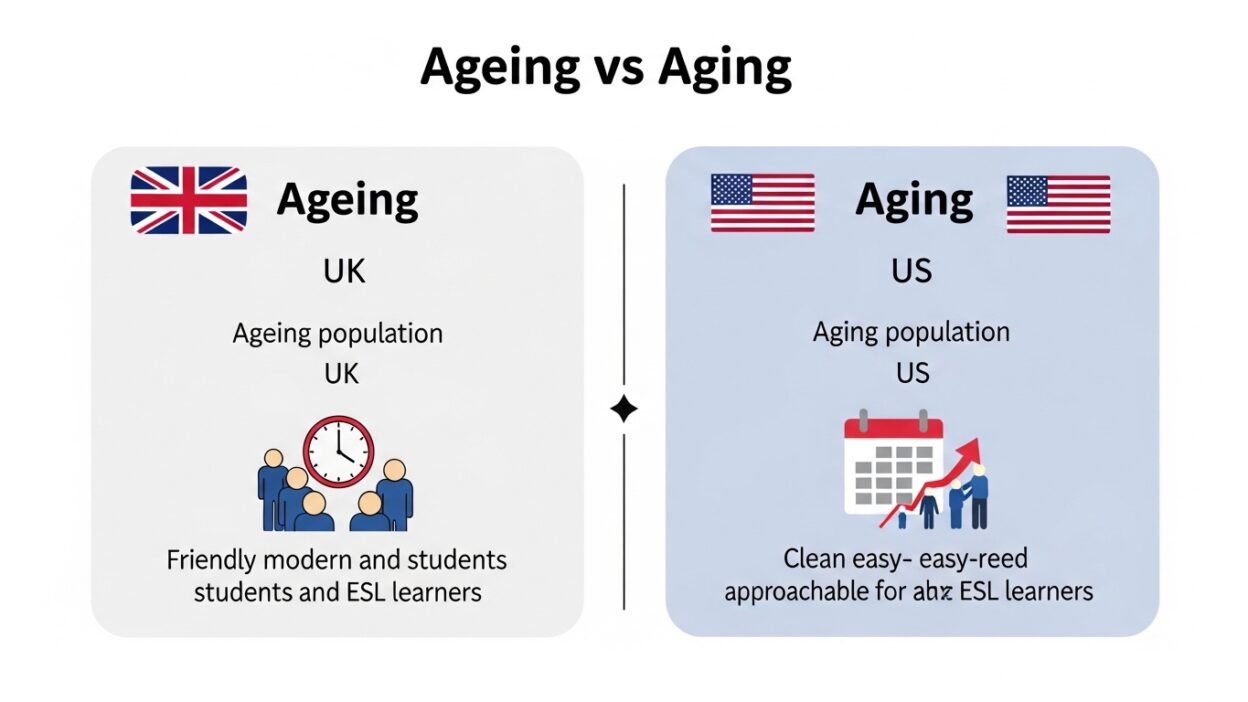
- Ageing → British English spelling (UK, Australia, India)
- Aging → American English spelling (USA, Canada)
- Both mean “getting older” or “the process of growing old”
- Pronunciation is almost the same: /ˈeɪdʒɪŋ/
- ✅ Use consistently depending on your English style
Memory Tip: Think:
- “e” = England → Ageing
- No “e” = America → Aging
Origin / Background
The difference comes from British vs American English spelling rules:
- British English often keeps the “e”, like in ageing, colour, favour.
- American English usually drops the “e”, like in aging, color, favor.
This spelling style difference has been around for hundreds of years.
Clear Explanation of the Difference
| Word | Spelling Style | Where It’s Used | Meaning / Example |
| Ageing | British English | UK, Australia, India | Getting older (ageing meaning), e.g., “The ageing population is increasing.” |
| Aging | American English | USA, Canada | Getting older (aging meaning), e.g., “The aging population is increasing.” |
Key Point: Both words are correct. Only spelling and region differ.
Comparison Table
| Feature | Ageing | Aging |
| English Type | British English | American English |
| Spelling | With “e” | Without “e” |
| Meaning | Same as aging | Same as ageing |
| Common Regions | UK, Australia, India | USA, Canada |
| Examples | Ageing population, Ageing process | Aging population, Aging process |
Which One to Use and When
- British English → Ageing
- American English → Aging
- In school, emails, or social media, be consistent.
Example:
- UK Email: “We are studying the effects of ageing on students.”
- US Email: “We are studying the effects of aging on students.”
Common Mistakes People Make
- Mixing both styles in the same text: ❌
- Wrong: “The aging process is natural, and ageing is beautiful.”
- Correct (UK): “The ageing process is natural.”
- Correct (US): “The aging process is natural.”
- Wrong: “The aging process is natural, and ageing is beautiful.”
- Thinking one spelling is wrong: ❌
- Both are correct depending on your style.
- Both are correct depending on your style.
- Pronouncing them differently: ❌
- Both sound almost the same: /ˈeɪdʒɪŋ/
- Both sound almost the same: /ˈeɪdʒɪŋ/
Everyday Real Life Examples
School / Homework:
- “We learned about the ageing population in Europe.” (UK)
- “We learned about the aging population in the USA.” (US)
Emails:
- UK: “Please read the report on ageing students’ performance.”
- US: “Please read the report on aging students’ performance.”
Social Media / Daily Life:
- Instagram: “Feeling great while ageing gracefully ✨”
- Tweet: “Tips for aging well 🏃♂️💪”
Food & Objects:
- “The ageing cheese tastes better after 6 months.”
- “This wine is aging beautifully in the cellar.”
Short Learning Section for Students
Tips for Remembering:
- Decide if you are learning British or American English.
- Remember: Ageing = UK / Aging = US.
- Pronunciation is almost the same.
- Practice writing examples in emails, school work, or social media.
Mini Exercise:
Choose the correct word:
- The ___ population is growing fast.
- Healthy ___ is important for everyone.
- This ___ wine is ready to drink.
Answers:
- Ageing (UK) / Aging (US)
- Ageing (UK) / Aging (US)
- Ageing (UK) / Aging (US)
FAQ: Ageing vs Aging
- Are ageing and aging the same?
- Yes, only spelling differs.
- Yes, only spelling differs.
- Which is correct?
- Both are correct. Use ageing (UK) or aging (US).
- Both are correct. Use ageing (UK) or aging (US).
- Do I pronounce them differently?
- No, both are pronounced the same.
- No, both are pronounced the same.
- Can I mix them in one sentence?
- No, pick one style.
- No, pick one style.
- Which one do newspapers use?
- UK newspapers use ageing, US newspapers use aging.
- UK newspapers use ageing, US newspapers use aging.
- Can I use it for food or objects?
- Yes, e.g., ageing wine, aging cheese.
- Yes, e.g., ageing wine, aging cheese.
- Why does UK English keep the “e”?
- To keep the traditional spelling and origin.
- To keep the traditional spelling and origin.
- Is one more formal?
- No, both are equally formal.
- No, both are equally formal.
Conclusion
Now you understand ageing vs aging clearly:
- Ageing = British English
- Aging = American English
- Both mean the same thing and sound the same
- Always use one style consistently
With this knowledge, you can read, write, and speak confidently. Next time you see these words, you’ll know exactly which one to use!