Many students and learners get confused between afterward vs afterwards. Both words look similar, mean almost the same thing, and are used to talk about something happening later. But which one should you use, and when?
This guide will explain everything in simple English, give real-life examples, show common mistakes, and even give you a mini cheat sheet to remember the rules.
Quick Answer: Afterward vs Afterwards
Here’s a simple summary:
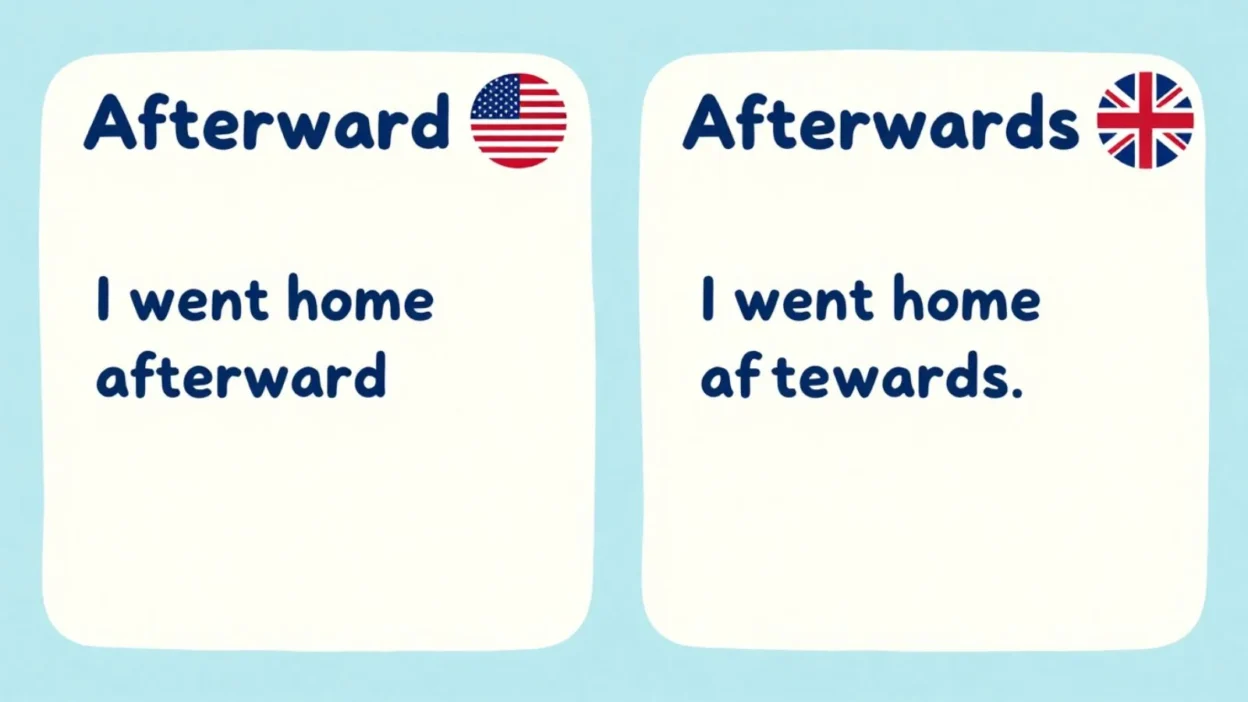
- Afterward → Mostly used in American English.
- Afterwards → Mostly used in British English.
- Both words mean later or at a later time.
- You can often use them interchangeably, but match the form to your audience.
- Example:
- American: I went to the store and went home afterward.
- British: I went to the store and went home afterwards.
- American: I went to the store and went home afterward.
What Do Afterward and Afterwards Mean?
Both words are adverbs, meaning they describe when something happens.
- Afterward meaning: “later, following something.”
- Afterwards meaning: Same as above.
Key tip for learners: Think of them as synonyms of “later.”
Origin of Afterward and Afterwards
- Afterward comes from old English, meaning “after in time.”
- Afterwards adds an -s, common in British English.
- The extra -s does not change the meaning—just like color vs colour.
Difference Between Afterward and Afterwards
| Feature | Afterward (American) | Afterwards (British) |
| Meaning | Later, at a later time | Later, at a later time |
| Usage | Common in writing & speech | Common in writing & speech |
| Placement in sentence | End of sentence or after a pause | End of sentence or after a pause |
| Example | He ate lunch and went home afterward. | He ate lunch and went home afterwards. |
Tip: Both words are neutral in formality and can be used in emails, conversations, or writing.
How to Use Afterward and Afterwards Correctly
- Decide your English style:
- American → afterward
- British → afterwards
- American → afterward
- Sentence position:
- Usually end of sentence: I finished my homework afterward.
- Or after a pause at the start: Afterwards, we played outside.
- Usually end of sentence: I finished my homework afterward.
- Replaceable with “later”:
- I went shopping afterward → I went shopping later.
- I went shopping afterward → I went shopping later.
- Avoid common mistakes:
- Wrong: Afterwards of the party, we cleaned up.
- Correct: Afterwards, we cleaned up.
- Wrong: Afterwards of the party, we cleaned up.
Common Mistakes Students Make
- Using the wrong regional form: She went shopping afterwards. (US → should be afterward)
- Adding extra words: Afterward after lunch… (just say Afterward…)
- Confusing grammar with other adverbs of time: e.g., beforehand, later, subsequently
Real Life Examples
1. Emails:
- American: I will send the report afterward.
- British: I will send the report afterwards.
2. Social Media:
- Went to the gym, and afterward grabbed a smoothie 🍓.
- We watched the movie and had ice cream afterwards 🍦.
3. News & Articles:
- The team celebrated afterward.
- The Prime Minister spoke, and the press asked questions afterwards.
4. Daily Conversation:
- I cleaned my desk and afterward relaxed with a book.
- I walked the dog and had a snack afterwards.
Practice Mini Exercise
Fill in the blanks with afterward or afterwards:
- I finished my homework, and ______ I went outside.
- She studied for the exam, and ______ she went to sleep.
- We had lunch, and ______ we visited the museum.
- He watched a movie, and ______ he called his friend.
Answers: 1. afterward (US) / afterwards (UK), 2. afterward / afterwards, 3. afterward / afterwards, 4. afterward / afterwards
Cheat Sheet: Afterward vs Afterwards
| Rule | Afterward | Afterwards |
| Region | USA | UK |
| Meaning | Later / at a later time | Later / at a later time |
| Sentence position | End or after a pause | End or after a pause |
| Replaceable with “later” | Yes | Yes |
| Common mistake | Using -s in US English | Using US form in UK English |
| Example | I ate lunch and went home afterward. | I ate lunch and went home afterwards. |
Quick Tip: For beginners, remember: American → afterward, British → afterwards. That’s it!
FAQ: Afterward vs Afterwards
1. Are afterward and afterwards the same?
Yes, they have the same meaning. The only difference is American vs British English.
2. Can I use afterward in British English?
Yes, it is understood, but afterwards is more common.
3. Can I use afterwards in American English?
Yes, it is understood, but afterward is preferred.
4. Where should I place these words in a sentence?
- Usually at the end: I went to the store afterward.
- Or after a pause at the start: Afterwards, we went home.
5. Are they formal or informal?
Both are neutral and can be used in any context.
6. Can I replace them with “later”?
Yes! I finished my homework afterward → I finished my homework later.
7. Do native speakers use both words?
Yes, Americans prefer afterward and Brits prefer afterwards, but both are widely understood.
8. How do I remember which to use?
Think USA = afterward, UK = afterwards. Simple!
Conclusion
Afterward vs afterwards are easy once you know the rules.
- Meaning: Both mean “later.”
- Region: Afterward = American English, Afterwards = British English.
- Usage: End of sentence or after a pause; can often be replaced with “later.”
With this guide, examples, mini exercises, and cheat sheet, you can confidently use afterward or afterwards in any situation emails, conversations, social media, or writing.