Many students and beginners mix up adjacent vs parallel. Both words talk about things being “beside” each other, but they mean very different things.
Understanding the difference between adjacent and parallel is easy if you know one key rule: touching vs not touching.
This guide explains everything with simple examples, visuals, quizzes, and daily life tips, so you will never confuse these words again.
Quick Answer: Adjacent vs Parallel
Here’s a simple way to remember:
- Adjacent
- Means next to or touching something.
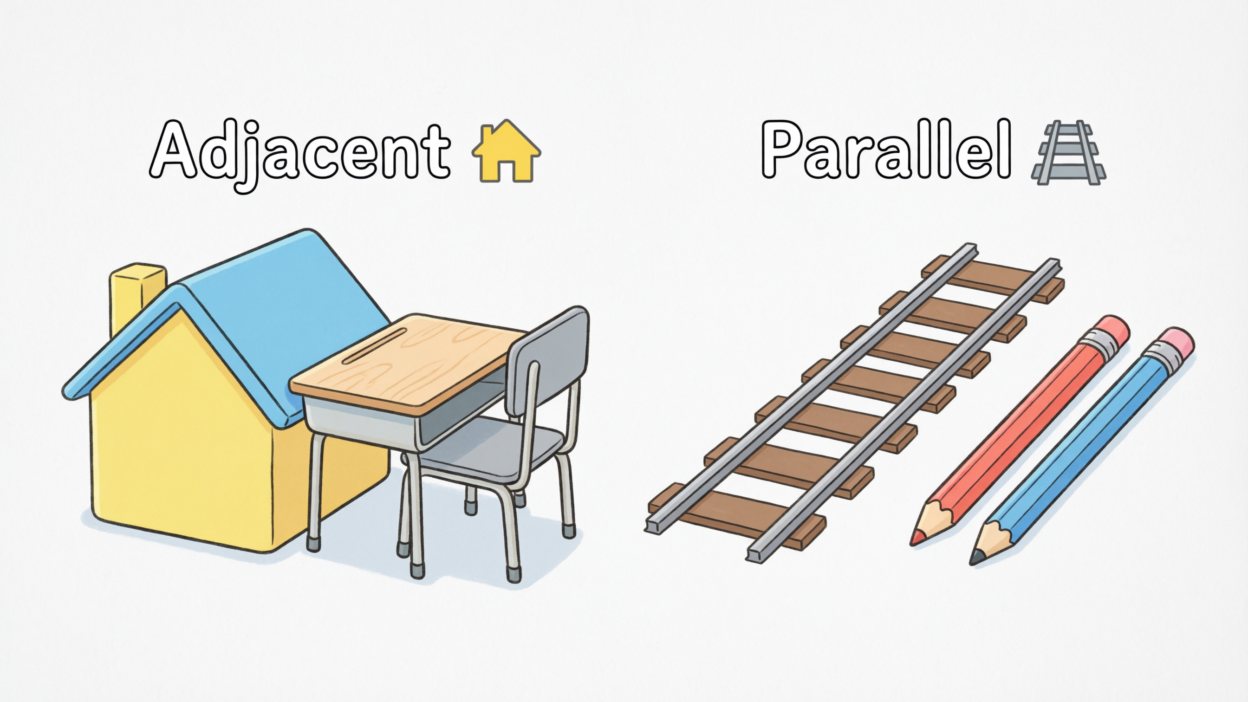
- Example: Your desk is adjacent to the classroom door.
- Means next to or touching something.
- Parallel
- Means side by side in the same direction, but never touching.
- Example: Railway tracks run parallel to each other.
- Means side by side in the same direction, but never touching.
Tip: Adjacent = touching | Parallel = never touching
Origin of the Words
- Adjacent comes from Latin adjacere, meaning “to lie near.”
- Parallel comes from Greek parallelos, meaning “beside one another.”
Even though both mean “beside,” the difference is contact vs direction.
Difference Between Adjacent and Parallel: Simple Explanation
| Feature | Adjacent | Parallel |
| Meaning | Next to or touching | Side by side, same direction, never touching |
| Distance | Can be 0 (touching) | Always constant, never zero |
| Direction | Not important | Must be the same |
| Example (Daily Life) | Desk adjacent to chair | Railway tracks are parallel |
| Example (Math) | Two angles sharing a side | Two lines that never meet |
| Visual | 🏠🏠 (houses touching) | 🛤️🛤️ (tracks side by side) |
Easy Trick:
- Adjacent = “neighbors or touching”
- Parallel = “same direction, never meet”
Everyday Examples of Adjacent and Parallel
Daily Life
- Your bed is adjacent to your nightstand.
- Lanes on the highway are parallel.
- Two buildings sharing a wall are adjacent.
Emails / Work
- Correct: “The meeting room is adjacent to the manager’s office.”
- Correct: “The new road runs parallel to the river.”
Math / Geometry
- Adjacent angles share a side.
- Parallel lines never meet, no matter how far they go.
Simple Analogies for Easy Memory
- Adjacent: Two slices of bread touching each other 🥪.
- Parallel: Two pencils lying side by side on a desk ✏️✏️, never crossing.
- Adjacent: Your neighbor’s house next door 🏠🏠.
- Parallel: Train tracks 🛤️🛤️.
Which One to Use and When
- Use adjacent when something is next to or touching another thing.
- Use parallel when things are side by side in the same direction without touching.
Tip for ESL learners:
Think “touch = adjacent”, “same path = parallel”.
Common Mistakes to Avoid
- Saying parallel when objects touch.
- Saying adjacent when objects never meet.
- Confusing the words in emails, news, social media, or math problems.
Quick Fix: Always ask:
- Are they touching? → Adjacent ✅
- Are they in the same direction but never meet? → Parallel ✅
Short Learning Section & Mini Quiz
Step 1: Identify if objects touch
- Yes → Adjacent
- No → Could be Parallel
Step 2: Check direction
- Same direction → Parallel
- Different direction → Adjacent
Mini Quiz:
- Your chair is next to your desk → ✅ Adjacent
- Train tracks → ✅ Parallel
- Two walls meeting at a corner → ✅ Adjacent
- Sidewalks along a street → ✅ Parallel
Answer Key: 1 Adjacent, 2 Parallel, 3 Adjacent, 4 Parallel
FAQ (Simple & Clear)
1. Can adjacent things be parallel?
- Yes, like two walls in a rectangle. They are parallel to each other and adjacent to other walls.
2. Are parallel lines always straight?
- Usually yes, but curved lines can be parallel if they follow the same path.
3. Can two objects be adjacent but not parallel?
- Yes, a desk and chair may touch each other (adjacent) but aren’t in the same direction.
4. Can a road be adjacent to a river?
- Yes, if it is right next to the river.
5. Can a river and a road be parallel?
- Yes, if they run side by side without crossing.
6. Is “adjacent” used in math?
- Yes, for angles, sides, or shapes that touch.
7. Is “parallel” used in math?
- Yes, for lines, planes, or vectors that never meet.
8. How can I easily remember the difference?
- Adjacent = touch / next to
- Parallel = same direction / never touch
Conclusion
Understanding adjacent vs parallel is easy when you remember:
- Adjacent = next to or touching
- Parallel = side by side, same direction, never touching
Use real life examples, analogies, and mini exercises to practice. Once you remember this, your English writing, speaking, and understanding will be much clearer.