Quick Answer:
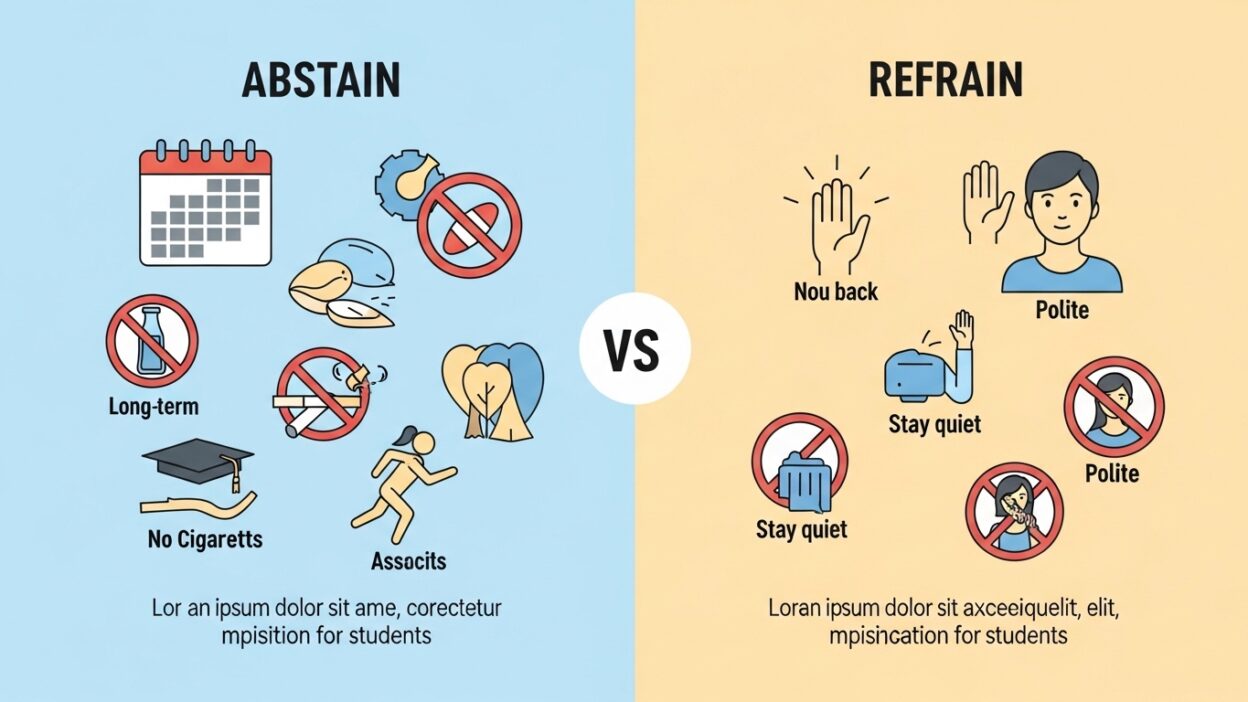
- Abstain = avoid something as a long-term choice or habit.
- Refrain = stop yourself from doing something right now or temporarily.
Memory Trick:
- Abstain = Habit
- Refrain = Right now
This article explains the difference between abstain and refrain with simple examples, charts, and exercises, so you’ll remember it forever. Perfect for students, ESL learners, and beginners.
Why Do People Get Confused Between Abstain and Refrain?
Many learners mix up these words because:
- Both mean not doing something.
- Both sound formal and appear in rules, emails, and polite instructions.
- Without context, it’s hard to know if it’s a long-term decision or a temporary action.
By the end of this guide, you’ll know exactly when to use abstain or refrain.
What Is the Difference Between Abstain and Refrain?
| Feature | Abstain | Refrain |
| Meaning | Long-term decision to avoid something | Short-term self-control in a situation |
| Duration | Usually ongoing or habitual | Temporary or immediate |
| Common situations | Health, religion, personal choices | Politeness, rules, momentary behavior |
| Example 1 | I abstain from drinking soda. | Please refrain from shouting. |
| Example 2 | He abstained from smoking. | She refrained from answering. |
Tip: If it’s a habit or principle → abstain. If it’s a specific moment → refrain.
Origin of the Words
- Abstain comes from Latin “abstinere”, meaning to hold back. Think choosing not to do something.
- Refrain comes from Latin “refrenare”, meaning to restrain. Think stopping yourself immediately.
How to Use Abstain vs Refrain in Real Life
1. Daily Life Examples
| Situation | Correct Word | Example Sentence |
| Avoiding candy for health | Abstain | I abstain from eating candy. |
| Not laughing in a meeting | Refrain | She refrained from laughing. |
| Skipping alcohol for a month | Abstain | He abstains from alcohol this month. |
| Not posting online during class | Refrain | Please refrain from using your phone. |
2. Emails & Social Media
- Abstain: “I have decided to abstain from social media during exams.”
- Refrain: “Please refrain from sending large attachments.”
3. News Headlines
- “Citizens are encouraged to abstain from alcohol during the festival.”
- “Fans were asked to refrain from entering the field after the game.”
Common Mistakes to Avoid
- Using abstain for short-term actions
❌ “I abstain from talking right now.”
✅ “I refrain from talking right now.” - Using refrain for long-term habits
❌ “I refrain from eating sugar every day.”
✅ “I abstain from eating sugar.” - Confusing polite requests
❌ “Please abstain from shouting.” (rare)
✅ “Please refrain from shouting.” (common)
Mini Exercise: Choose the Correct Word
Fill in the blanks:
- During exams, I __________ from social media. (abstain / refrain)
- Please __________ from making noise in the library. (abstain / refrain)
- He decided to __________ from alcohol for a month. (abstain / refrain)
- She __________ from laughing during the serious meeting. (abstain / refrain)
Answers: 1. abstain 2. refrain 3. abstain 4. refrain
Short Learning Section for Students and Beginners
- Abstain = Habit / long-term → “I choose not to do it.”
- Refrain = Right now / temporary → “I stop myself from doing it now.”
Extra Tip: Remember the first letters: A = Abstain = Always / Habit, R = Refrain = Right now / Moment.
Frequently Asked Questions (FAQ)
- Can I use abstain and refrain interchangeably?
- No. Abstain = long-term, Refrain = short-term.
- No. Abstain = long-term, Refrain = short-term.
- Is refrain more polite than abstain?
- Yes, especially in instructions or warnings.
- Yes, especially in instructions or warnings.
- Can abstain be used in social media posts?
- Yes, often for habits or challenges.
- Yes, often for habits or challenges.
- Is refrain formal?
- Mostly, but can be used in polite daily speech.
- Mostly, but can be used in polite daily speech.
- Can I say “I refrain from alcohol”?
- Yes, but it sounds temporary. “I abstain from alcohol” is more natural.
- Yes, but it sounds temporary. “I abstain from alcohol” is more natural.
- Which is easier to remember?
- Use the memory trick: Abstain = Habit, Refrain = Right now.
- Use the memory trick: Abstain = Habit, Refrain = Right now.
- Can children use these words?
- Yes. Examples: “I refrain from shouting” or “I abstain from candy.”
- Yes. Examples: “I refrain from shouting” or “I abstain from candy.”
- Are these words common in daily speech?
- “Refrain” appears more in polite requests; “abstain” in health, religion, or formal writing.
- “Refrain” appears more in polite requests; “abstain” in health, religion, or formal writing.
Conclusion
Abstain and refrain both mean not doing something, but:
- Abstain = long-term choice or habit
- Refrain = short-term self-control or polite request
Use the memory trick, the comparison chart, and mini exercises to practice. Now you can confidently use abstain vs refrain in school, emails, social media, and daily life.
Remember:
- Habitual → Abstain
- Momentary → Refrain
Practice a few sentences every day, and the difference will stick in your mind forever!